
For decades, international student mobility was told as a demand-side story: rising middle classes in China, India, and Nigeria would keep filling Western campuses. Families wanted degrees, universities supplied them, and demand seemed inexhaustible.
But the center of gravity has shifted from demand to supply. Today, student mobility is increasingly structured by HALO—housing, affordability, labor, and openness. I unpack these supply-side drivers below.
The Old Demand Story
The old logic was simple: if student numbers dipped, the causes were cyclical—exchange rates, recessions, visa delays.
That story fit the high-growth era of globalization. After the 2008 Great Recession, demand from China and India surged, filling Western campuses and convincing many that the pipeline would be endless.
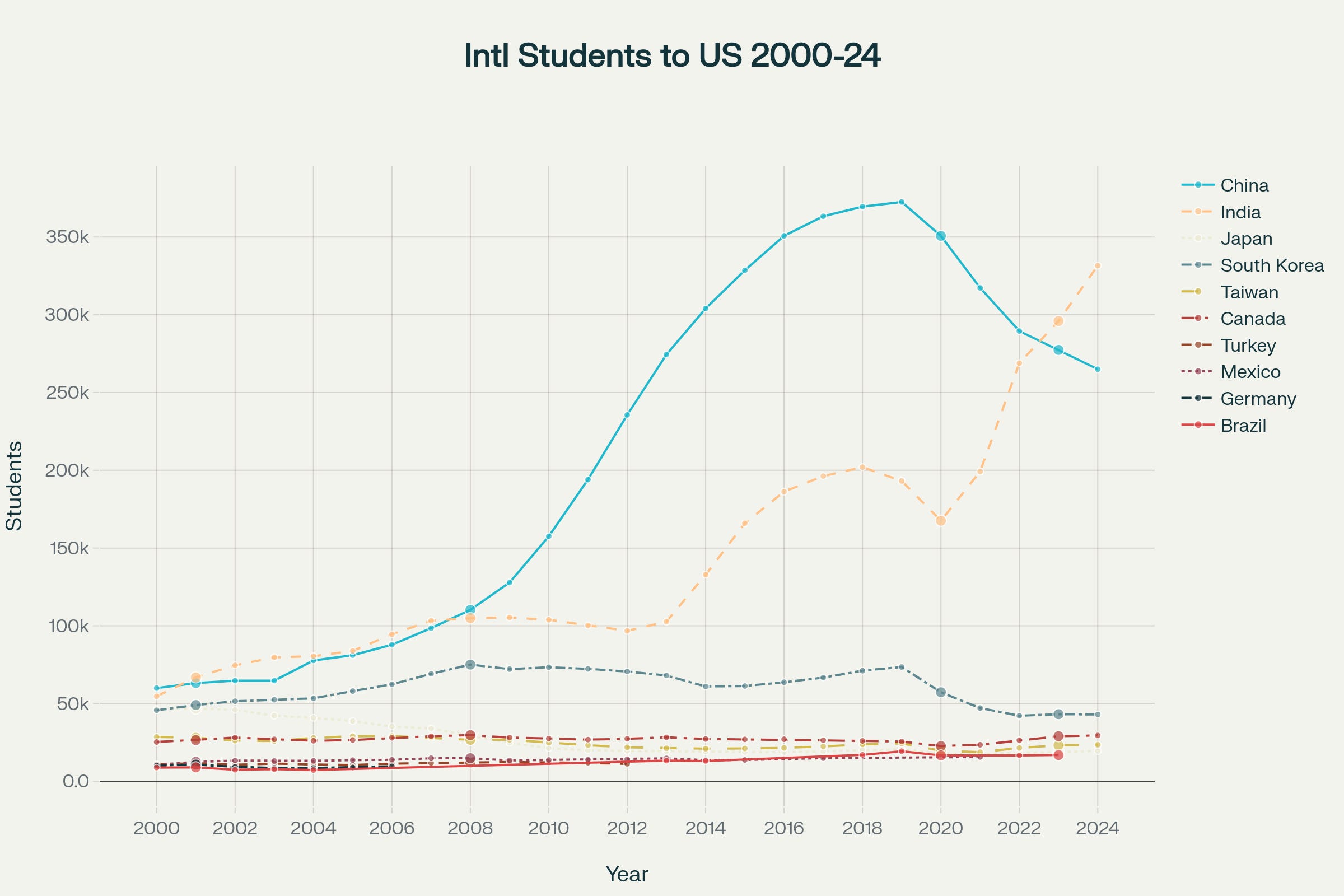
Universities leaned into this story, selling themselves in a global marketplace.
But demand no longer explains the map.
NAFSA warns up to 150,000 fewer students may arrive in the US this fall due to US visa restrictions and downward visa trends. Local businesses lose critical revenue as fewer students spend in their communities.
Meanwhile, policy uncertainty shapes reality the way economic uncertainty spooks markets.
Trump occasionally signals a less restrictive approach, like when he told a reporter: “the college system would go to hell very quickly” without international students—even floating 600,000 from China—inciting massive pushback from his MAGA base.
The new USCIS director has testified he plans to eliminate Optional Practical Training (OPT), the administration has moved to formally end “duration of status” for F, J, and I categories, and H‑1B reform is advancing toward a wage- or salary-weighted selection system
Last year’s SEVIS data indicate another all-time high. But is demand really endless? Is this expected drop a temporary blip or an inflection point?
U.S. growth never reflected the demand for education alone. It reflected capacity—an early HALO alignment of housing, affordability, labor, and openness.
In the past, housing wasn’t a bottleneck, affordability was less of an issue, labor markets were open to talent, and a broad political mandate for openness.
Student flows are shaped by host nations, not just demand from families.
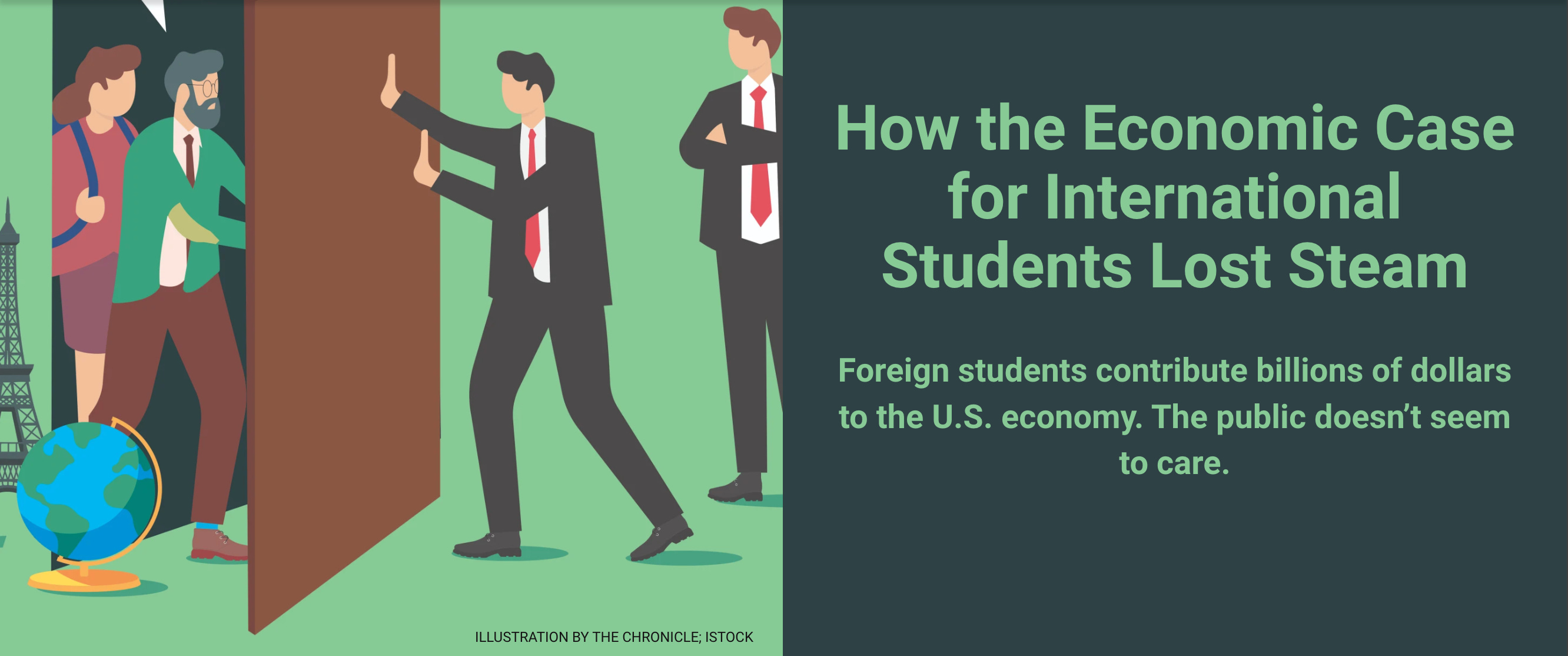
It was in this context that Karin Fischer asked me a critical question—one that also heard when I spoke on a panel at the National Academies of Sciences, Engineering, and Medicine (NASEM) this summer.
If the old economic-impact arguments for international students have lost political resonance, what comes next?
It forced me to confront how national stress increasingly reshapes global flows—without erasing the power of individual aspiration, but often overriding it.
Nations, Not Students, as the Supply-Side Drivers
The question is no longer how many students want to move. The question is how many societies can actually absorb them. Four stress points matter most. I’ll return to these in the next section with a broader framework.
Demand is rising like water, but national strategies are the valves — and now the story is where students actually flow, not how much volume sits in the system.
Housing
Housing is the immovable ceiling. No matter how strong demand or how welcoming the policy, students cannot enroll without a bed. Canada’s rental vacancy in 2024 barely reached 2.2%—just 1.6% in Vancouver—leaving little slack. In the UK, the shortfall is estimated at 600,000 student beds, with new supply lagging far behind. Without accommodation pipelines, mobility stalls at the door.
Affordability
The real ceiling in the U.S. is affordability. Tuition at $30–50K a year—before rent—already costs 8–10× annual income in India and 20–25× in Nigeria. Families are shifting to hubs charging $5–10K, or €2–5K in Europe. Canada and Australia cluster at $15–25K, while Asian hubs compete at $3–8K. U.S. universities now function as luxury goods: accessible to the wealthy, but pricing out many of the “best and brightest.” Currency swings and tariff shocks only magnify the risk. Volatility, not aspiration, defines the boundary of demand.
Labor
Labor markets set the outer boundary of study-to-work mobility. Canada capped 2024 study-permit approvals at about 360,000 (≈–35% vs. 2023). The UK barred most taught-master’s dependants from January 2024, triggering a sharp drop in visas, with only a modest early-2025 recovery under tighter rules. In the U.S., growing frictions around post-study work signal additional constraints on pathways.
Openness
Openness rests on political mandate and public trust. When trust erodes, pathways narrow. In Canada, concerns over housing and labor drove new limits: off-campus work capped at 24 hours per week and post-graduation work permits tied to shortage fields. In Australia, skepticism about whether students are “genuine” led to scrapping the two-year work extension, tightening visa scrutiny, and a 29% drop in student-visa grants in early 2024.
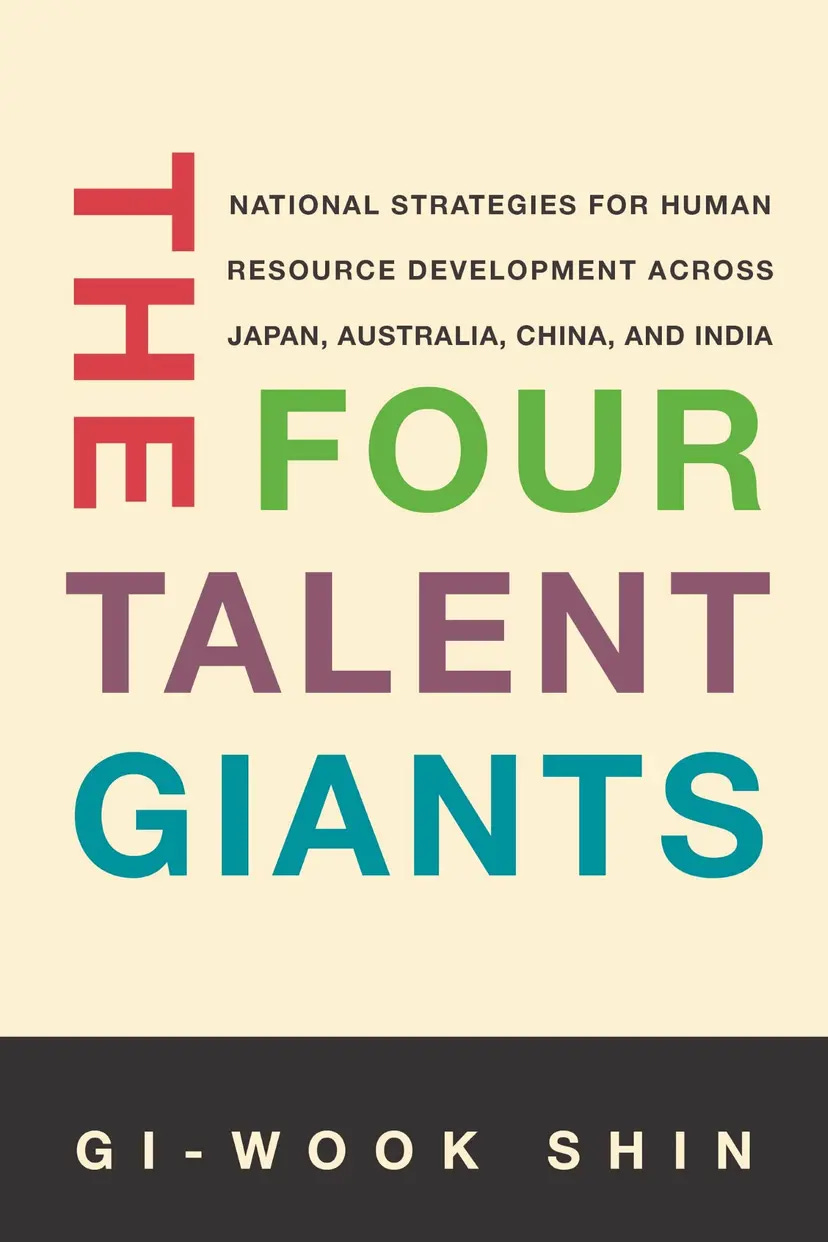
Gi-Wook Shin’s The Four Talent Giants: National Strategies for Human Resource Development Across Japan, Australia, China, and India (Stanford University Press) is a useful lens: nations manage talent as portfolios—brain train, brain gain, brain circulation, brain linkage.
By 2030, projections suggest more than 10 million internationally mobile students worldwide — up from about 6 million in 2023.
The HALO Effect
HALO = Housing, Affordability, Labor, Openness.
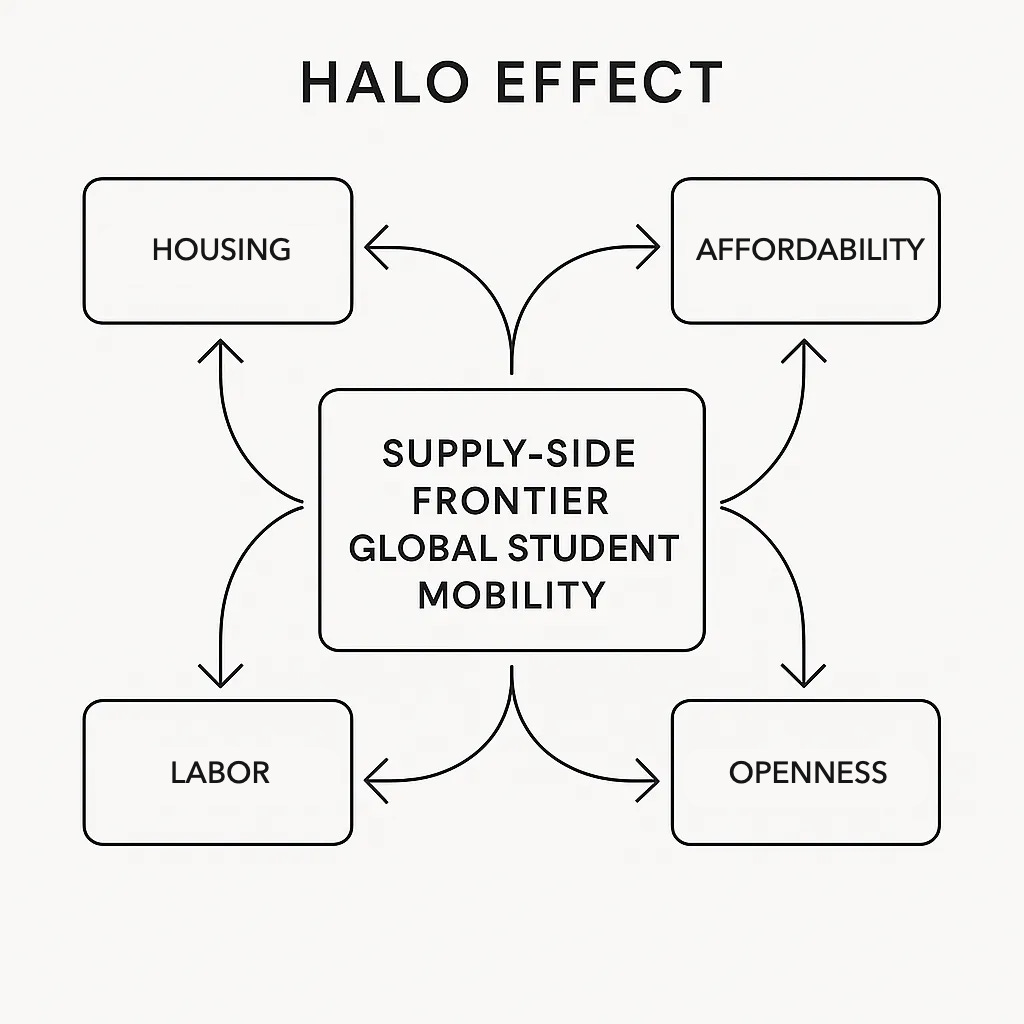
These four factors define the supply-side future of student mobility—the maximum sustainable inflow a country can host.
Housing: accommodation stock that sets hard ceilings.
Affordability: the price point and currency risk that constrain access.
Labor: whether national labor markets rely on students to backfill shortages.
Openness: the political mandate and public trust that make flows sustainable.
Policy moves the HALO frontier outward when governments add housing, align labor shortages with work rights, and build legitimacy. It moves it inward when caps, restrictions, or backlash close pathways.
HALO complements Shin’s portfolio lens. HALO shows the ceilings; Shin shows the rebalancing. Portfolios map the options; HALO marks the limits. Together, they explain why mobility is no longer just about demand—it’s about how nations under stress design, constrain, and manage talent.
Mobility flows are now governed by national capacity, not endless demand.
This flip in logic isn’t new.
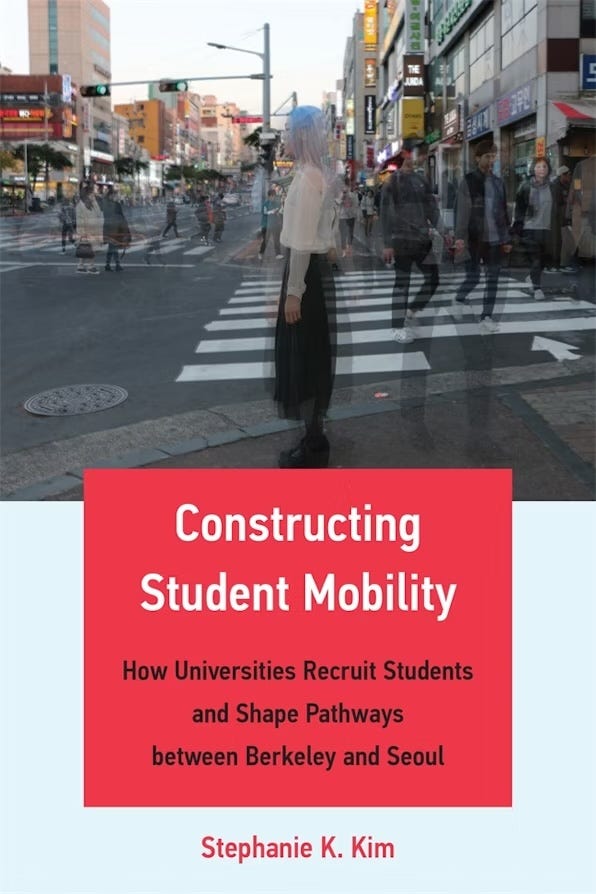
In Constructing Student Mobility (MIT Press, 2023), Stephanie Kim showed how universities—not students—engineer pathways, turning aspiration into institutional revenue and prestige. She flipped the comfortable story of students “choosing” into the reality of universities sorting and steering.
My argument extends outward: today it is nations, not just universities, whose structural limits—housing, labor, legitimacy—determine where mobility happens.
Why This Is Structural, Not Cyclical
It is tempting to see volatility as another swing in the cycle. But today’s bottlenecks are structural:
Housing shortages stem from decades of underbuilding.
Fiscal exposure is locked in by disinvestment.
Demographic declines are fueling economic anxieties and workforce shortages
Immigration politics are embedded in law and legitimacy.
These aren’t temporary shocks. They’re new baselines—hard to undo, but still open to policy change and bold visions for the future.
In In Our Interest: How Democracies Can Make Immigration Popular (Columbia University Press), Alexander Kustov argues that immigration support in democracies is conditional—it rises when policies deliver tangible benefits. His new Substack, Popular by Design, starts from those principles and tests them in practice: not just what immigration is, and what it could become

The Rock–Paper–Scissors of Security Logics
A crude way to see the shift is rock–paper–scissors.
Economics once dominated—the rock-solid economic argument beat everything. Today, security beats economics, while diplomacy, weakened by cuts to aid and exchange, is treated like the naïveté of a bygone era.
Now flows are judged by security logic: who has access, what research is open, which collaborations are “trusted.”
Think of it as rock–paper–scissors. Economics used to win — growth justified everything. Now security beats economics, and diplomacy tries to contain security. The balance keeps shifting, but the old hierarchy is gone.
We’ve all heard the once-rock-solid talking point: “International students contribute $43 billion to the U.S. economy.”
Under economic logics, that’s proof of success — jobs created, tuition paid, exports booming.
But many national policymakers now read it through security logics. $43 billion is not just contribution, it’s reliance. It raises sharper questions: who are these students, what knowledge do they access, where does it flow?
To some, the number signals vitality. To others, it signals vulnerability. The economic frame says scale it up. The security frame says tighten the valves.
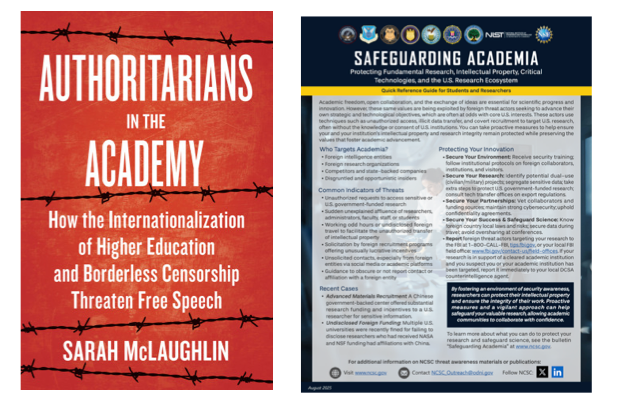
The recent guide, Safeguarding Academia, from the Director of National Intelligence warns that foreign adversaries exploit open universities to steal research and repress students.
Sarah McLaughlin’s Authoritarians in the Academy (Johns Hopkins University Press) makes a crucial point: authoritarian influence in global higher education is not hypothetical but real. She documents cases where universities bent to political pressure and students abroad faced surveillance or retaliation.
These concerns about academic freedom cannot be minimized. They go to the heart of higher education’s core values: intellectual freedom.
Both texts name hard realities: authoritarian influence is real, and research security matters.
The threats are real. But the greater danger may be eroding what makes U.S. higher education strong: openness, pluralism, autonomy.
The risk is overcorrection: treating all international engagement as compromised.
The goal is proportionality: tiered safeguards where risk is highest, openness where risk is low.
Otherwise, in trying to protect the academy against foreign influence, we risk hollowing out the very freedoms that have given America its global advantage.
Because, unlike a child’s game of rock-paper-scissors, this isn’t a zero-sum game. The choice isn’t security vs openness.
Nations that treat economics, security, and diplomacy as a flywheel—where international connections fuel economic growth and economic growth contributes to national security, fueling innovation and strength in the new geopolitical landscape.
The Hard Reset: Are You Ready for the New Era of Internationalization?
If demand is plentiful but capacity scarce, the challenge is not technical but adaptive.
A technical challenge can be solved with expertise. An adaptive challenge cannot. It lacks easy fixes. It requires shifts in values, roles, and relationships.
Adaptive challenges demand new learning. They force institutions to face reality, experiment, and adapt.
We are in such a moment. The shift from demand to supply means internationalization has entered a new era—defined by limits in housing, labor, legitimacy, and security.
🛰 1945–1989 (Cold War Era): Bipolar competition — state-sponsored, ideologically driven mobility through bilateral agreements and cultural diplomacy.
🌍 1990–2008 (Market Liberalization): U.S. hegemony and globalization — universities and students drive market-oriented mobility; Anglo-American dominance, Bologna Process, education as export.
⚖️ 2009–2022 (Strategic Competition): Rising multipolarity and economic nationalism — diversification of destinations, regional hubs, securitization of research and student flows.
🛡 2023–present (Multipolar Securitization): Fragmented blocs and technological rivalry — Strategic Education Blocs form; middle powers assert agency; hybrid mobility becomes normalized.
We’re not in a cyclical downturn; a structural realignment is underway.
Adaptive leadership here means redesigning capacity itself: building housing pipelines, aligning labor markets, and clarifying pathways. Marketing tweaks won’t fix what is structural.
Student Flows in the New Global Order
For decades, student mobility ran through narrow channels—South to North, East to West. Today those streams are widening and diffusing: more students, moving through more places, at more equal rates.
What we are entering resembles a Global Middle Ages of Internationalization: a period not of collapse but of overlapping authorities, fragmented power, and regional logics. The metaphor matters because it resists the linear assumption that globalization naturally integrates; it suggests instead a world of durable pluralism and contested legitimacy.
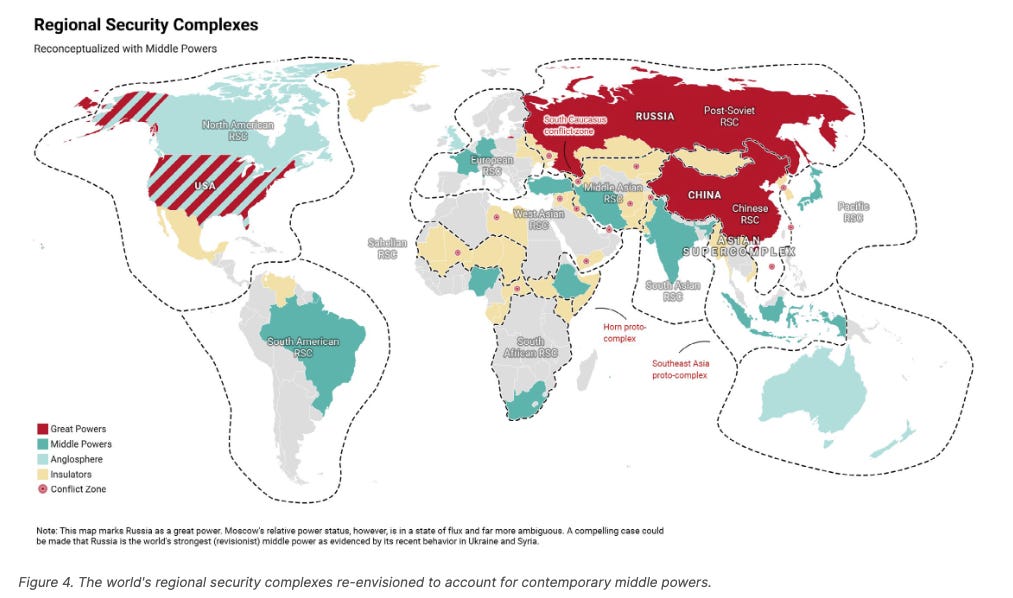
Nations always shaped flows, but in the last globalization wave free trade of goods meant free trade of students; now tariffs return, and so does the end of endless demand.
Student flows are barometers of resilience, not consumers with cash to spend. Their movement is now seen as part of national strategies for talent development. They indicate whether societies have the capacity to expand housing, integrate labor, and manage legitimacy without fracturing.
Nations that treat mobility as infrastructure (UAE, Singapore, Saudi Arabia) will capture the next generation of innovators. Those that don’t will find demand abundant but capacity scarce.
Mobility is also forward-looking. It shows which societies have the agility to thrive, the openness to endure, and the legitimacy to lead in a more mobile, multi-nodal, and meteorologically unpredictable world.
Countries that recognize this won’t just capture talent. They will redefine what “center” means in the world’s knowledge and innovation networks.
The Upshot
Demand hasn’t collapsed.
What has collapsed is the assumption that demand guarantees mobility. The bottlenecks are structural.
Are U.S. universities doomed? Hardly.
The Boston Consulting Group’s Talent Tracker shows the U.S. continues to attract top students, even as Gulf nations rise.
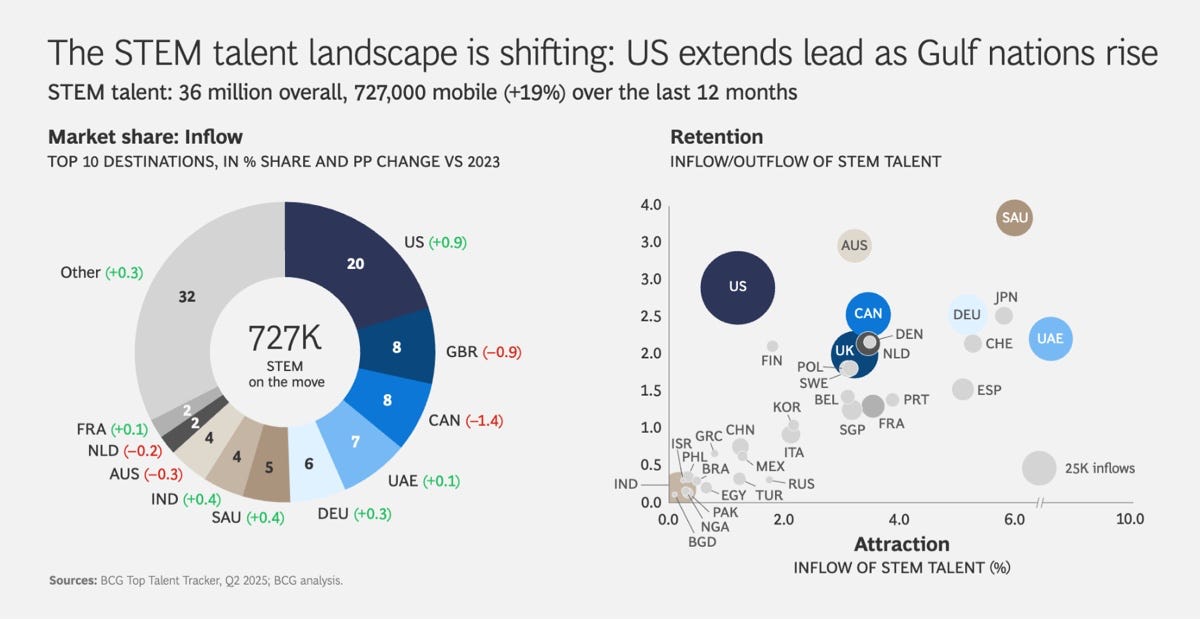
But international students — long positioned as consumers in a global marketplace — now signal national concerns, with governments pulling policy levers to redirect their flows. Different nations have different HALO approaches:
🟢 Emerging Builders – UAE, Singapore, Saudi Arabia – Treat student mobility as infrastructure. Build housing, build institutions, tie it to national visions. Legitimacy flows from top-down planning, not democratic buy-in.
🟠 Fiscal-Dependent Hosts – United States, United Kingdom, Australia. Big revenue, big reliance, brittle politics. Housing shortages and backlash make these giants volatile. They can absorb flows, but not without constant turbulence.
🔵 Selective Gatekeepers – Canada, France, Denmark. Calibrated control. Capacity stays tight, legitimacy stays high. Canada’s recent cuts show the model: open, but only up to the ceiling.
🔴 Constraint-Locked Systems – Italy, South Africa, Brazil. Demand is there. Supply isn’t. Housing, money, consensus—all missing. They stay stuck, regardless of educational quality.
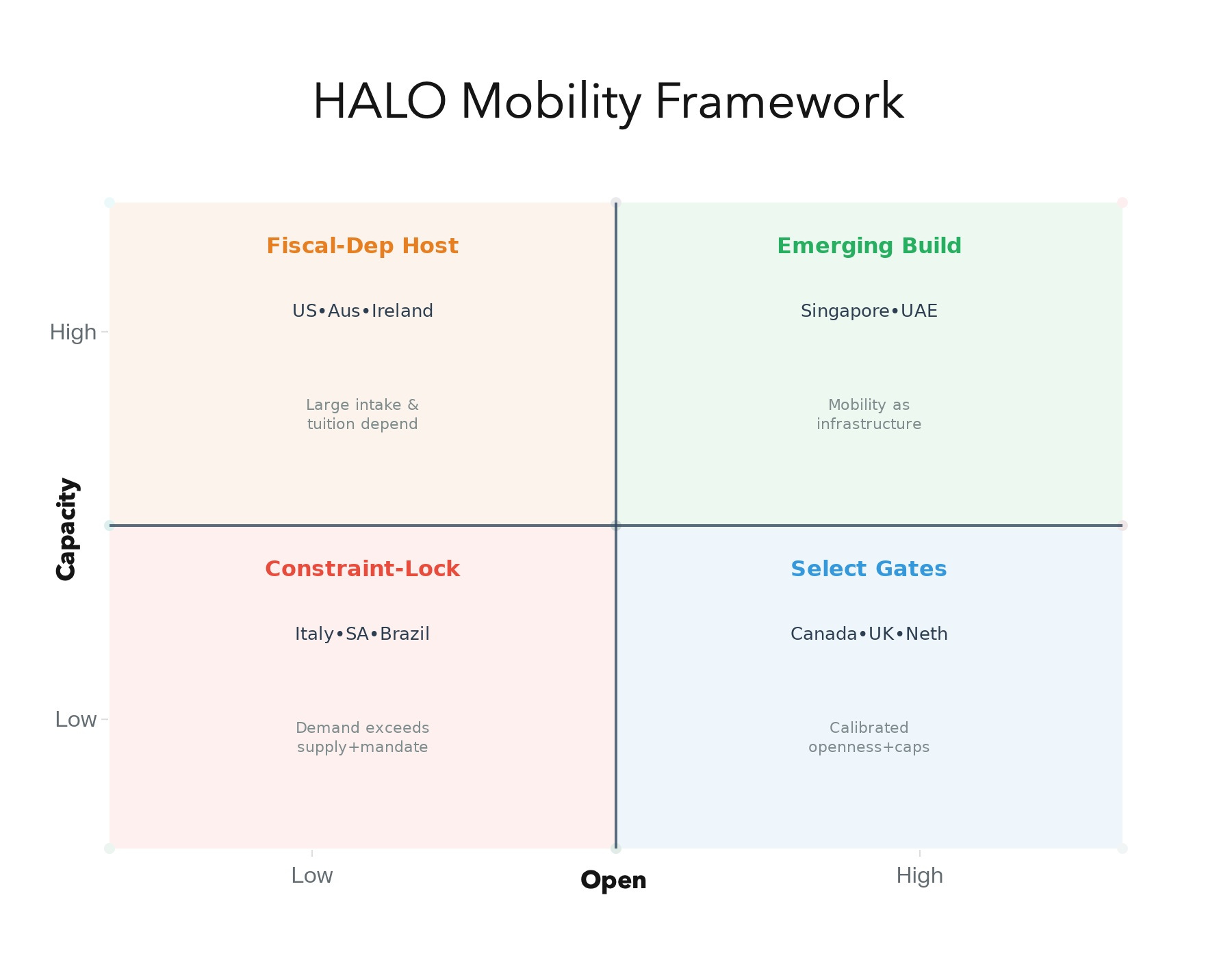
Mobility now tells us which nations can adapt under stress, build trust under pressure, and still open pathways for talent.
The future isn’t set by demand but by how countries confront scarcity—whether they merely ration it, or reimagine capacity itself through agility, openness, and institutional innovation.
What do you think?
Is the economic case for international students obsolete, merely dormant, or overdue for a more nuanced framing?
Of the HALO constraints—housing, affordability, labor, openness— which one is truly decisive, and which do we consistently misdiagnose?
As flows diffuse, are we missing the upside? What new advantages emerge when mobility decentralizes rather than concentrates in the “Big Four” destinations?
I’d love to hear your thoughts, and so would the growing Distributed Progress community. I hope you’ll share your insights and perspectives in the comments.