
ARGUMENT IN BRIEF:
On July 21, the White House released A New Golden Age, an ambitious attempt to rethink American science policy for a new era.
The report retains Vannevar Bush’s core principle that government should fund research markets will not, while proposing substantial changes to how funding is allocated.
Its strongest case is that American science has become slow, bureaucratic, and narrow; the core uncertainty is whether disruptive reform will strengthen the system rather than destabilize it.
The high-stakes wager: America may weaken the openness that made its scientific system the world’s most attractive and productive.
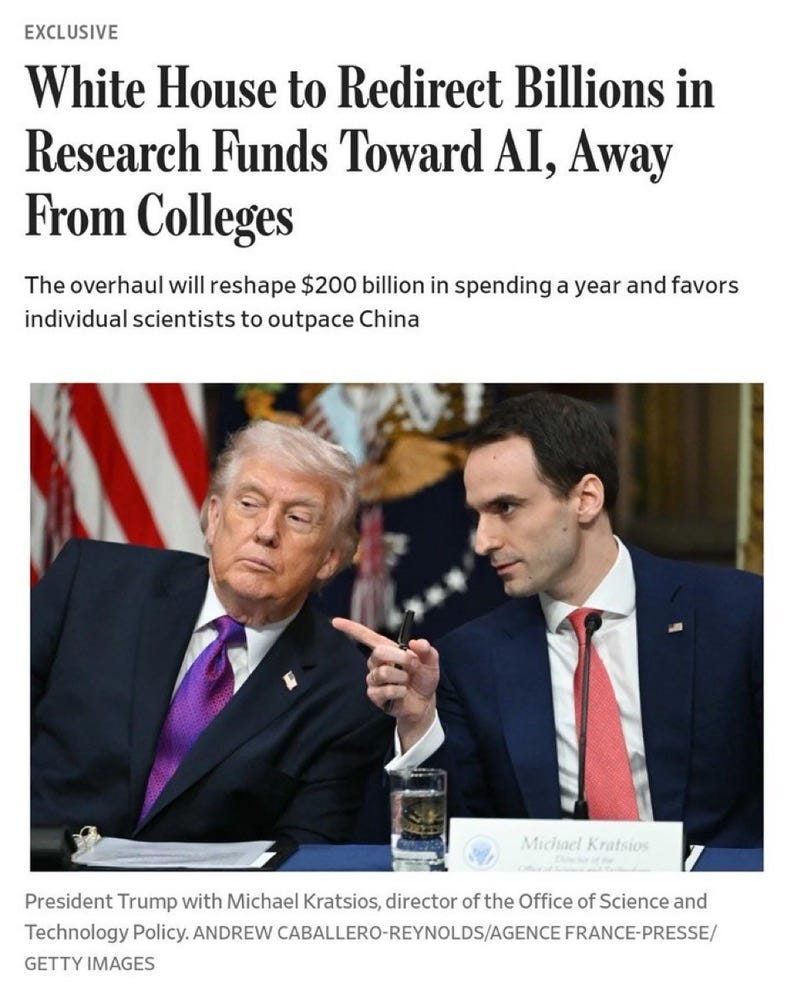
On July 21, 2026, the White House Office of Science and Technology Policy released Science: A New Golden Age, a 123-page report to the President from OSTP Director Michael Kratsios.
It says, in its own voice, what for a year could only be inferred from executive orders and budget lines: the settlement Vannevar Bush designed in 1945 is over, and its replacement now has a founding document.
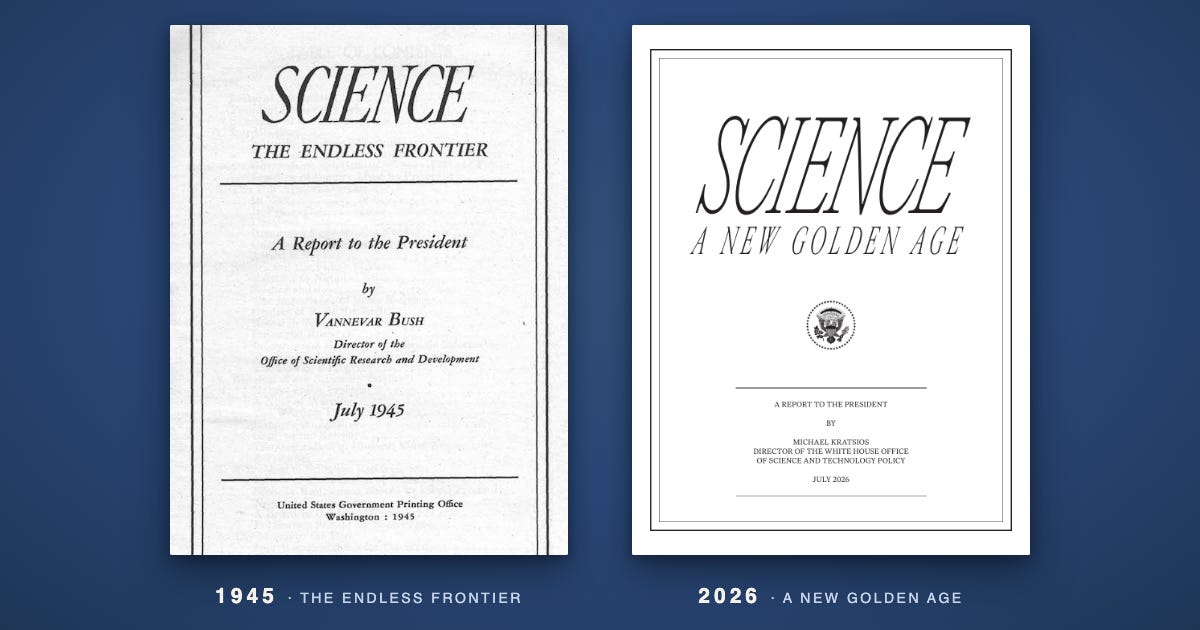
I have spent that year making the case of what could only be inferred from executive orders and budget lines. It sounded, at times, overstated: that the United States is not merely cutting science budgets but replacing one logic of how a nation organizes science with another.
I made the argument to Alex Kafka for the Chronicle of Higher Education's report, “The High-Stakes Hunt for Research Funds”, as wel as in conversations with reporter from Nature, Ars Technica, and Neue Zürcher Zeitung, and in an op-ed in the Washington Post, along with several pieces on this Substack.
Now, with A New Golden Age, my argument has a primary text.
The report’s authors believe they are reviving Bush and inaugurating a renaissance after an anemic period of scientific progress. Critics will likely point to the reallocation of the $200-$300 billion R&D portfolio away from universities as the latest act of the Trump administration’s overreach.
Read the report. Draw your own conclusions.
But one thing is for sure: this is not “just another report”.
The FY2028 R&D Priorities Memo, released the same day, makes it clear: implementation begins immediately.
Not “Just Another Report”
Vannevar Bush’s Legacy
The report is unmistakably framed in the lineage of the most consequential science-policy document in American history.
In November 1944, Franklin Roosevelt wrote a letter to his science adviser, Vannevar Bush, asking how the machinery of wartime science should serve the peace. Bush’s answer, Science: The Endless Frontier, gave us the National Science Foundation, federally funded university research, and the compact that has governed American science ever since.

In March 2025, Donald Trump wrote a letter to Michael Kratsios that names the precedent explicitly: “just as FDR tasked Vannevar Bush, I am tasking you.” A New Golden Age is the answer to that letter. It names Bush on its first substantive page, quotes him at least 11 times, reactivates his frontier metaphor, and closes with a section titled “As We May Build,” a transposition of “As We May Think,” the companion essay Bush published the same month.
A New Golden Age wants to be read as the FDR-to-Bush exchange performed for the next great era of American science.
A Logic That’s Already at Work
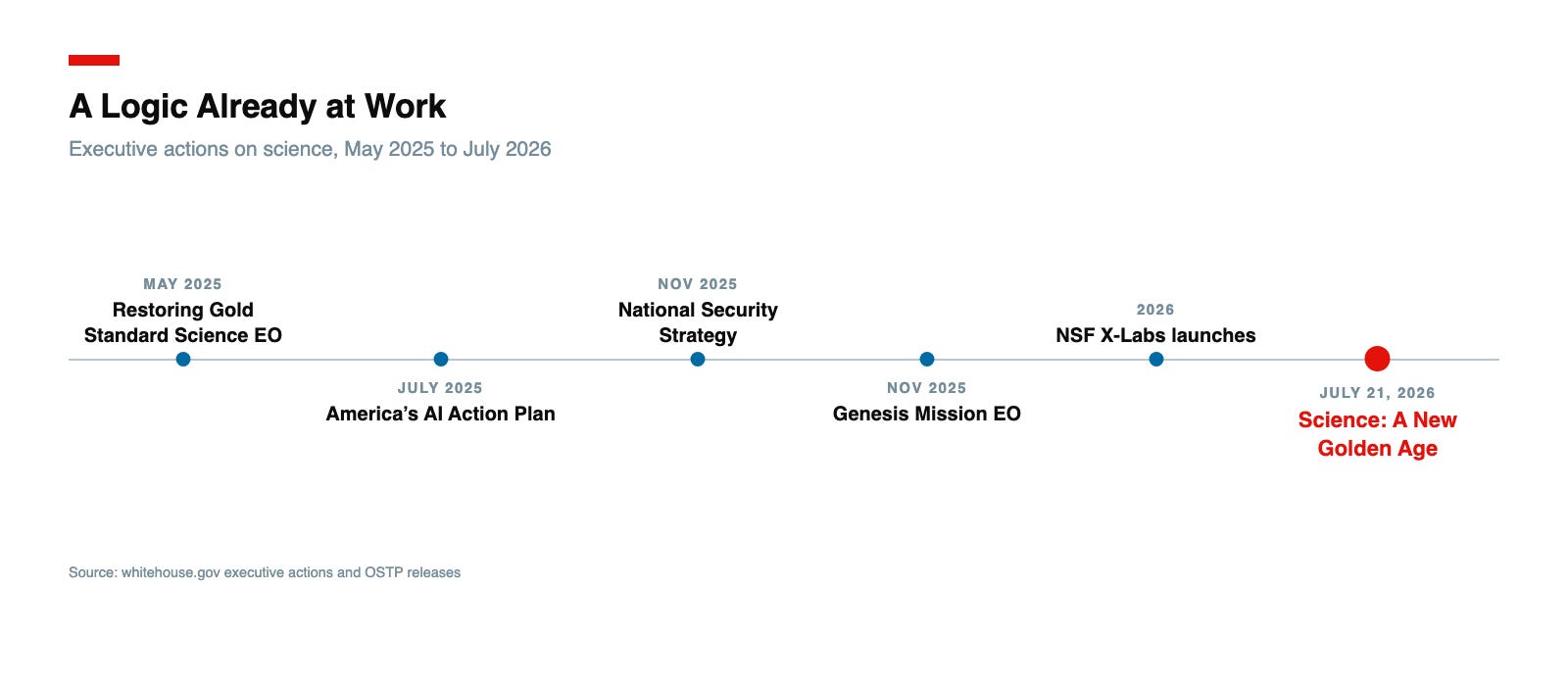
It outlines a logic already restructuring science.
The past 18 months have been building towards this larger vision: the Restoring Gold Standard Science executive order, America’s AI Action Plan, the National Security Strategy, the Genesis Mission, the NSF’s X-Labs program funding research organizations outside universities altogether.
A Technological Republic Lineage
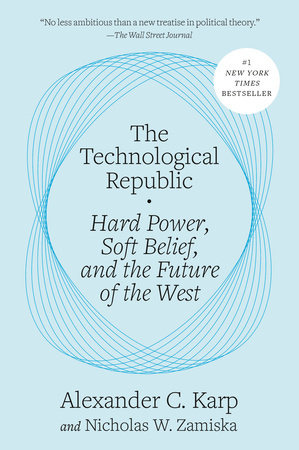
Readers of Alex Karp and Nicholas Zamiska’s The Technological Republic will find its sensibility in this report: the Manhattan Project as the lost ideal of state, science and a postwar partnership with industry adrift.
When a reporter for the Neue Zürcher Zeitung asked me to characterize the administration’s approach, I characterized it as government science operating as a “sovereign wealth fund”: the state as an investor constructing a portfolio, including high-risk bets, while reserving the right to pull bets that disappoint.
The report uses nearly the same language I used as an analytic frame in that conversation with the reporter, directing federal agencies to:
“…evaluate their own performance as capital allocators” and to “construct portfolios with the intentionality of a serious investor.”
Metascience Goes Mainstream
It’s also clear the metascience movement has presidential-level support.
Caleb Watney and Jenn Gustetic produced a useful field guide synthesizing, “The Six Camps of Metascience,” with a decade of evidence of how science funding could work better. A New Golden Age borrows from that evidence heavily and, in most places, faithfully.
Still, a substantial part of the report is not metascience. The critique of DEI criteria in grant review, the domestic-first stance on talent, and the national-security framing of research are political commitments, so the report integrates evidence-based metascience with the administration’s ideological concerns braided throughout.
The Sagan Standard: Extraordinary Claims Require Extraordinary Evidence
Science has been charged with being “too incremental”.
This report is anything but.
Papers and patents are, by a widely cited (and since contested) measure, becoming less disruptive. Drug discovery produces fewer cures per dollar. Researchers lose more than 40% of their funded time to administration.
The author’s clearly believe stagnation is real and, to get back on track, science needs a jolt.
So, A New Golden Age proposes the boldest restructuring of American science since 1945.
It is written with a controversial pretext:
that the operating system of the most successful scientific enterprise in human history should be substantially reorganized,
And a bold assumption:
that this reorganization will renew rather than break the enterprise.
Boldness is not a vice. Extraordinary measures may be necessary. And, if so, Carl Sagan’s standard should apply:
“Extraordinary claims require extraordinary evidence.”
The report should be held to the same standards it holds to science. So, in Sagan’s spirit, I want to practice a discipline philosopher Daniel Dennett codified from the game theorist Anatol Rapoport in Intuition Pumps and Other Tools for Thinking.
Here are the steps:
Restate the position fairly.
Concede what is true.
Admit what you learned.
Only then object.
1. The Report’s Argument
Here is what A New Golden Age actually argues.
The Endless Operating System
The principles of The Endless Frontier were right and remain right:
Scientific progress is essential to national security, health, and prosperity, and government must fund the research that markets will not.
But principles are not processes.
Bush’s structure was built for a specific moment:
a linear model in which basic research flows in one direction to application,
universities as the near-exclusive home of that basic research,
a funding architecture channeled through consensus peer review, and
a cost-reimbursement system that pays universities’ overhead (indirect costs) to cover overhead of hosting the work.
This approach ensured 1945 and FDR’s charge to Bush of how wartime scientific lessons could be “profitably employed in times of peace”, an era when the nation’s chief rivals lay in ruins, industry did little fundamental research, and universities were the institutions best situated for open-ended inquiry.
The World Has Changed
The linear model no longer describes how discovery works:
Modern breakthroughs require recursive iteration between fundamental and applied research, as examples from the transistor to AI’s transformer architecture demonstrate.
Industry now funds and performs basic research at a scale rivaling the federal government. Increasingly, the most talented scientists leave universities because the tools (and money) of cutting-edge science exist outside the university.
The system has atrophied: 24-month lead times for grants, investigators spending nearly 1/2 their time on paperwork, consensus panels that fund the least divisive ideas, indirect cost rates that subsidize administrative expansion.
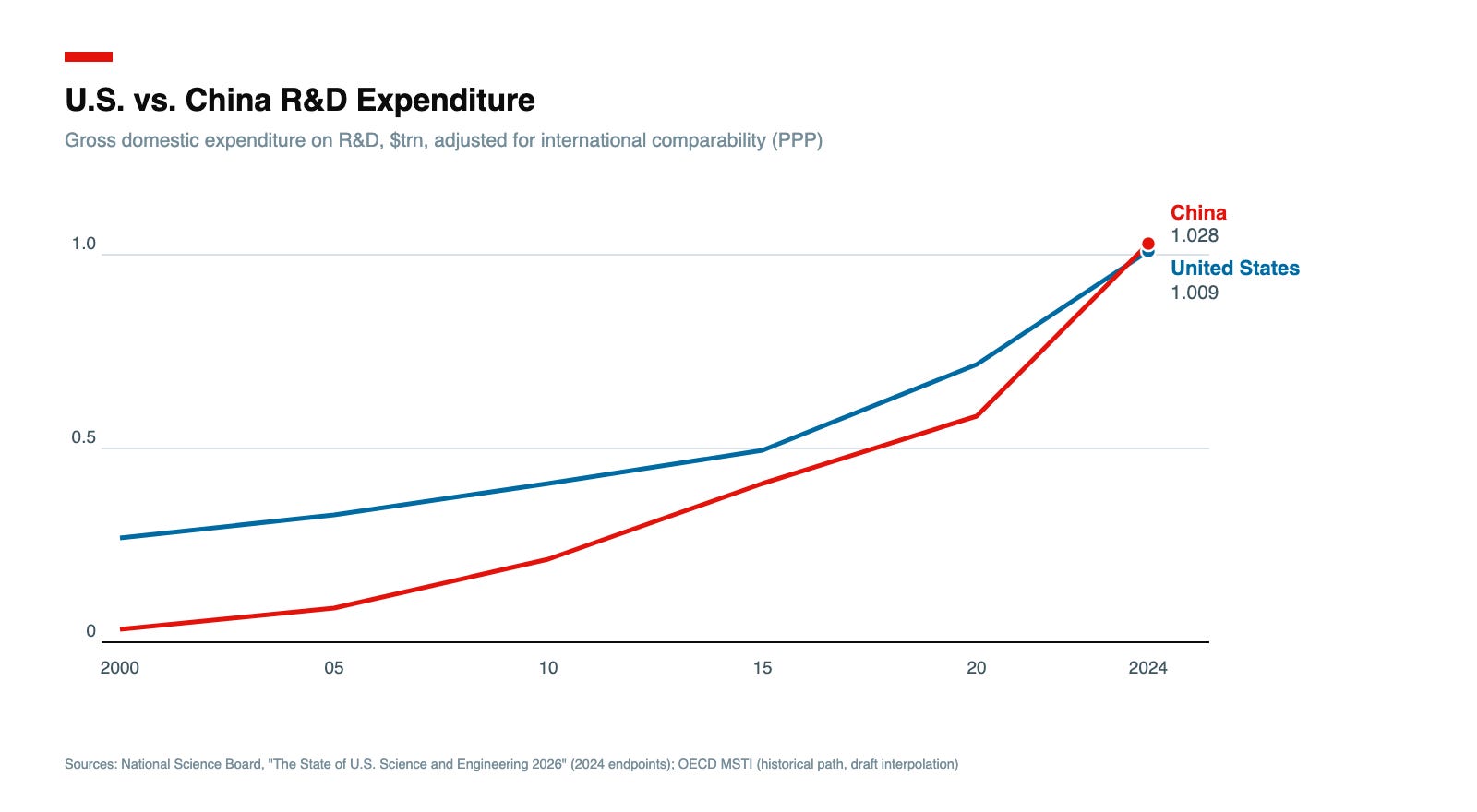
The United States faces a new scientific superpower: China has been scaling up science through state capacity; it’s spending on fundamental research grew more than tripled from 2013 to 2023.
A Structural Response is Necessary
Therefore, the report argues, the response must be significant and structural. You can’t just throw more money at the problem. As Kratsios has argued elswhere:
“Spending more money on the wrong things is far worse than spending less money on the right things.”
Vannevar Bush himself would recognize the moment, the report insists:
Bush wrote for a landscape that has “completely transformed,” and his pioneering spirit “calls us to do what he would surely do today: reimagine the entire enterprise for our time.”
The United States must:
Fund and build a wider range of research organizations: universities, yes, but also focused research organizations (FROs), ARPA-style agencies where individual program managers make bold bets, and X-Labs teams with operational autonomy and milestone funding.
Leverage selection mechanisms drawn from the metascience: golden tickets, fast grants, prizes, regranting. Shift funding from slow, legacy institutions and bet on talented people (and teams), not just projects.
Set bold national scientific goals, from fusion to AI-accelerated discovery through the Genesis Mission, and leave it to scientists to execute.
Rebuild the marriage of science and manufacturing. Ensure the returns of science accrue to the Americans who fund it.
Free the individual scientist from the bureaucracy that has accreted around them.
The report sets its own benchmark for success in a sentence:
“A decade from now, American researchers should look back at our work and say: ‘The vital questions I could not pursue then, I am free to pursue now.’”
2. Where I Agree
The Problems are Real
Administrative burden is now a well-documented feature of scientific work. Peer review’s conservatism is one of the best-established findings, and reform-minded researchers like Rick Born have proposed serious fixes from inside. The reproducibility crisis is real, and the report’s account of it is substantially accurate. Indirect cost rates and administrative bloat deserve scrutiny.
Basic-Applied Boundaries Blur
The linear model became shorthand for the Bush settlement:
Universities were expected to do basic research with federal funding → industry converted knowledge into applications.
But NSF’s 2020 75th-anniversary reflection on The Endless Frontier noted that “lab-to-market pipelines are not necessarily linear,” because complex problems often force researchers back toward fundamental questions.
On that load-bearing premise, the NSF in 2020 and the OSTP in 2026 agree that the basic/applied boundary is blurred, even as they disagree whether the university-centered system should remain the default institutional form.
A More Diverse Ecosystem is Needed
Funding different types of institutions is merited by the evidence.
I said as much to the Zurich reporter: I saw the NSF’s announcement of a new initiative to launch and scale a new generation of transformative independent research organizations to advance breakthrough science as an experiment worth running. Science needs more institutional forms than the university department and the corporate lab.
Targeted Metrics Hurt Science
I also agree with the report’s invocation of Goodhart’s law, an argument anthropologist Marilyn Strathern stated plainly:
“When a measure becomes a target, it ceases to be a good measure.”
The metrics of science have become targets and stopped being good measures. I’ve argued as much in “The New Analytics-Industrial Complex: Data, Governance, and Power”: much of what has gone wrong in the academy follows from four decades of optimizing the measurable.
3. What I Learned
The report’s thesis, “the shape of an institution determines the shape of the science it produces,” is a genuinely useful lens.
I have been describing Trump 2.0 as a move toward federal control over science, given the OMB proposal to rewrite the Uniform Guidance for grants, which would apply across NIH, NSF, and other agencies. The proposal would give senior political appointees greater oversight of discretionary awards and broaden agencies’ authority to suspend or terminate grants when they no longer align with agency priorities or the national interest.
A Golden Age helped me see that the approach has two dimensions:
It centralizes mission-setting, the what of science, while
decentralizing allocation, the how, through regranting, program-manager discretion, and distributed new performers.
4. My Criticisms
Now, my objections.
Why Zero-Sum?
The report proposes an experiment to be financed by reweighting a roughly $200 billion federal R&D system. It does not give a full breakdown of what % of funding will go to universities versus other organizations. But, any experiment should not defund the control group (universities) on a hypothesis alone without proportionate evidence. X-Labs and the new institutional forms are worth funding, but not as a zero-sum contest paid for out of the university system they are meant to be tested against. In other eras, X-Labs would be an addition, judged against a stable baseline over a decade.
Politicizing Science
The report’s stated theory is the restoration of “gold-standard science”, merit, and trust. But if the administration’s goal is to de-politicize science, it must live up to its own standards.
A Washington Post/“Ripple” survey of U.S. researchers reported that Trump administration policies have increased self-censorship, stress, and recruiting difficulty across the scientific workforce.
Nature documented the screening of grant applications against a list of 235 disfavored terms, “gender” and “climate change” that has left hundreds of applications in administrative limbo.
NIH awards are lagging even when Congress has appropriated the money.
Kratsios’s principle, “spending more money on the wrong things is far worse than spending less money on the right things,” is one I can defend.
But, for open-inquiry science to work, scientists must believe the administration is living up to its own “gold standard”, not adding uncertainty and politics on top of administrative burdens.
It is also unclear whether “gold-standard science” leaves meaningful room for humanities and qualitative social-science research, which have long-standing traditions of quality but are not easily captured by the report’s proposed evaluative standards. These fields are mentioned only marginally, while the report’s center of gravity is AI, engineering, and mission-oriented science; the “portfolio” language appears to favor strategic research investments rather than the full range of humanistic and interpretive inquiry.
Narrow Counsel
Bush reserved “the internal control of policy, personnel, and the method and scope of the research to the institutions themselves” as “of the utmost importance.”
The report argues:
“Bush would be the first to recognize that the landscape in which fundamental research is conducted has completely transformed.”
Government sets the what, scientists keep the how, sounds like a modernization of that principle, but it’s not clear Bush would agree. And, I grant that Bush may have agreed with the report’s diagnosis and many of it’s reform efforts and perhaps championed the boldest ones.
But it’s not at all clear he would believe the evidence it cites meets Sagan’s “extraordinary” standard for the extraordinary restructuring it outlines.
Bush’s process was publicly auditable: four named committees, comprising nearly 50 appointments across universities, industry, foundations, education, and government, produced formal reports that were published in full.
A New Golden Age rightly insists science needs “a wider range of performers” yet, it is unclear the range of performers who were consulted in developing, and how competing evidence and interests were weighed.
The administration’s broader advisory ecosystem raises a related, though distinct, concern. While Bush recognized the connection between science and industry, it’s hard to fathom he would support a President’s Council of Advisors on Science and Technology, composed “12 technology chiefs — and one academic”, including leaders from Nvidia, AMD, Oracle, Google, Coinbase, and Andreessen Horowitz.
Scientists know Feynman’s first principle: “The first principle is that you must not fool yourself — and you are the easiest person to fool.” The best way not to “fool ourselves” is to expose our ideas to intense scrutiny by people who hold different views.
Talent Contradiction
The report wants American dominance in AI-accelerated science while treating the talent system that has attracted scientists to America as an abuse to be ended rather than an advantage to be renewed.
The report states:
“...we train extraordinary global talent at enormous expense, only to lose this effort when foreign governments recruit them to build up their own technological enterprises.”
This makes the case form reform to make it easier to retain the high-skilled talent America attracts, not doubling-down on a slow, legacy system that too-often makes it difficult for brilliant scientists (and their families) to stay and contribute to the reserach enterprise, build companies, and more.


To be clear, high-skilled immigration needs real reform. The Institute for Progress has long argued that the current system misallocates scarce talent and weakens innovation, and that allocating visas more strategically would produce substantially greater economic value.
The redirection has already begun: Nature’s latest graduate survey reports that prospective doctoral students are rethinking the United States as a destination.
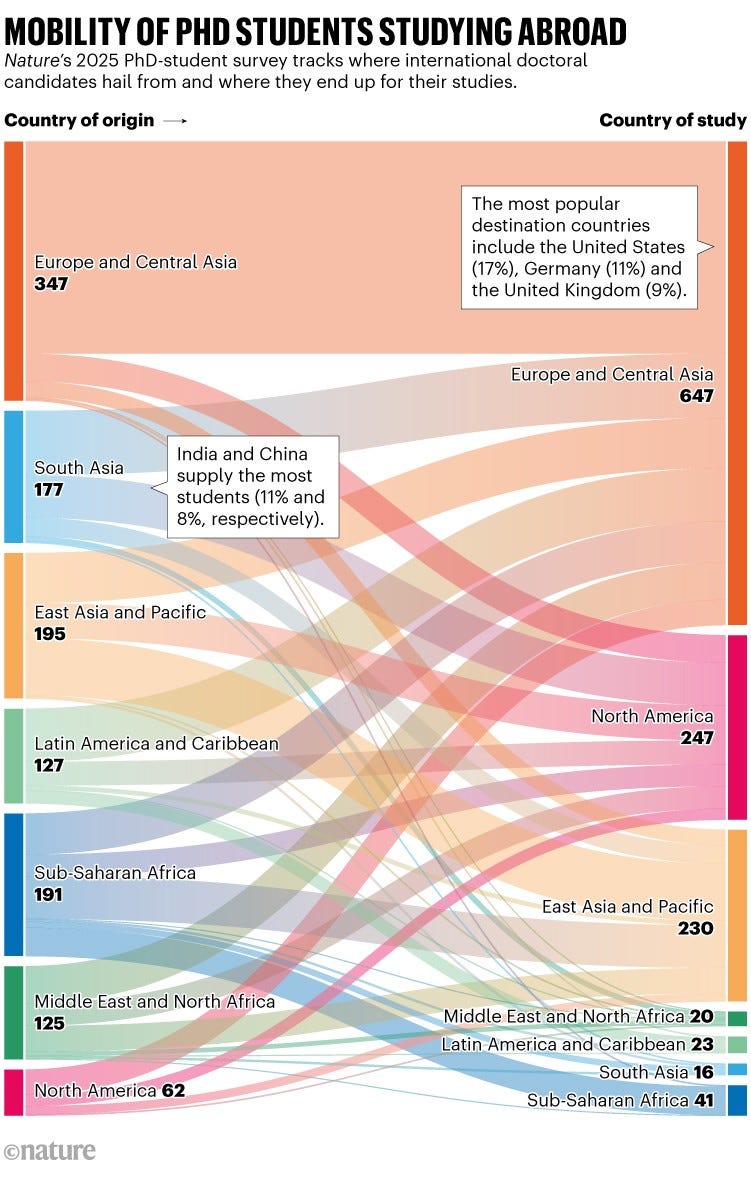
Moreover, the administration’s final rule ending duration of status, issued 5 days before the report, caps the admission period at 4 years and requires international PhD students to seek an extension through USCIS if they need more time. That could also interrupt the OPT pipeline for students whose doctoral programs and training periods last 5 to 7 years, adding uncertainty and paperwork for many students whose programs run longer.
The Unmaking of the University?
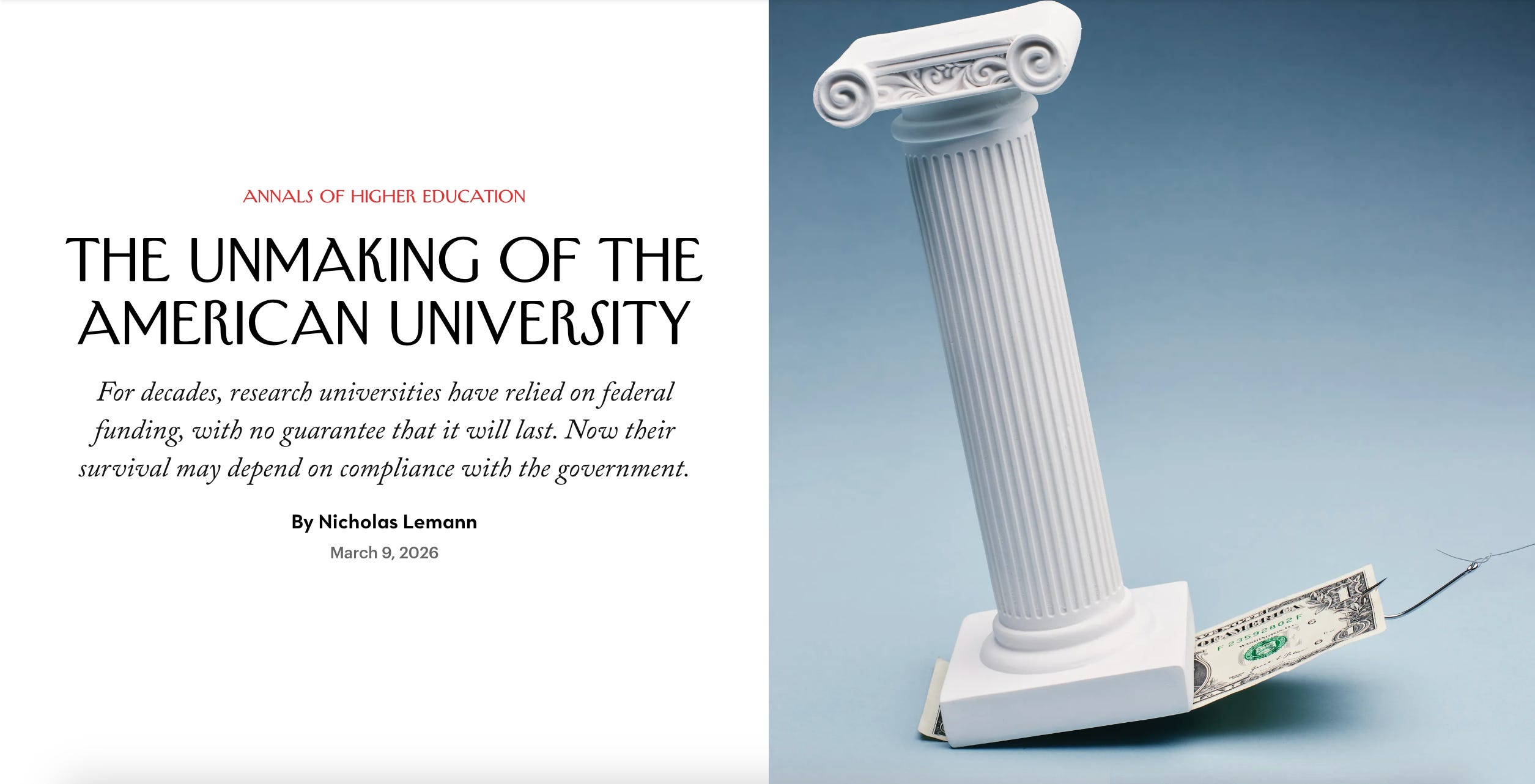
Nicholas Lemann’s New Yorker essay, “The Unmaking of the American University,” reads the whole program as political conquest, with the funding theory as pretext, as does H. Holden Thorp’s “Another Red Alert for American Science” in Science.
Thorp might view my generous interpretation as tone-deaf, arguing that “the very values that have defined scientific merit for 80 years are obliterated.” Lemann might argue that A New Golden Age is a rationalization for cuts already made and for the consolidation of political control.
Although I don’t share their perspective, they may well be right.
Same Principles, Different Systems
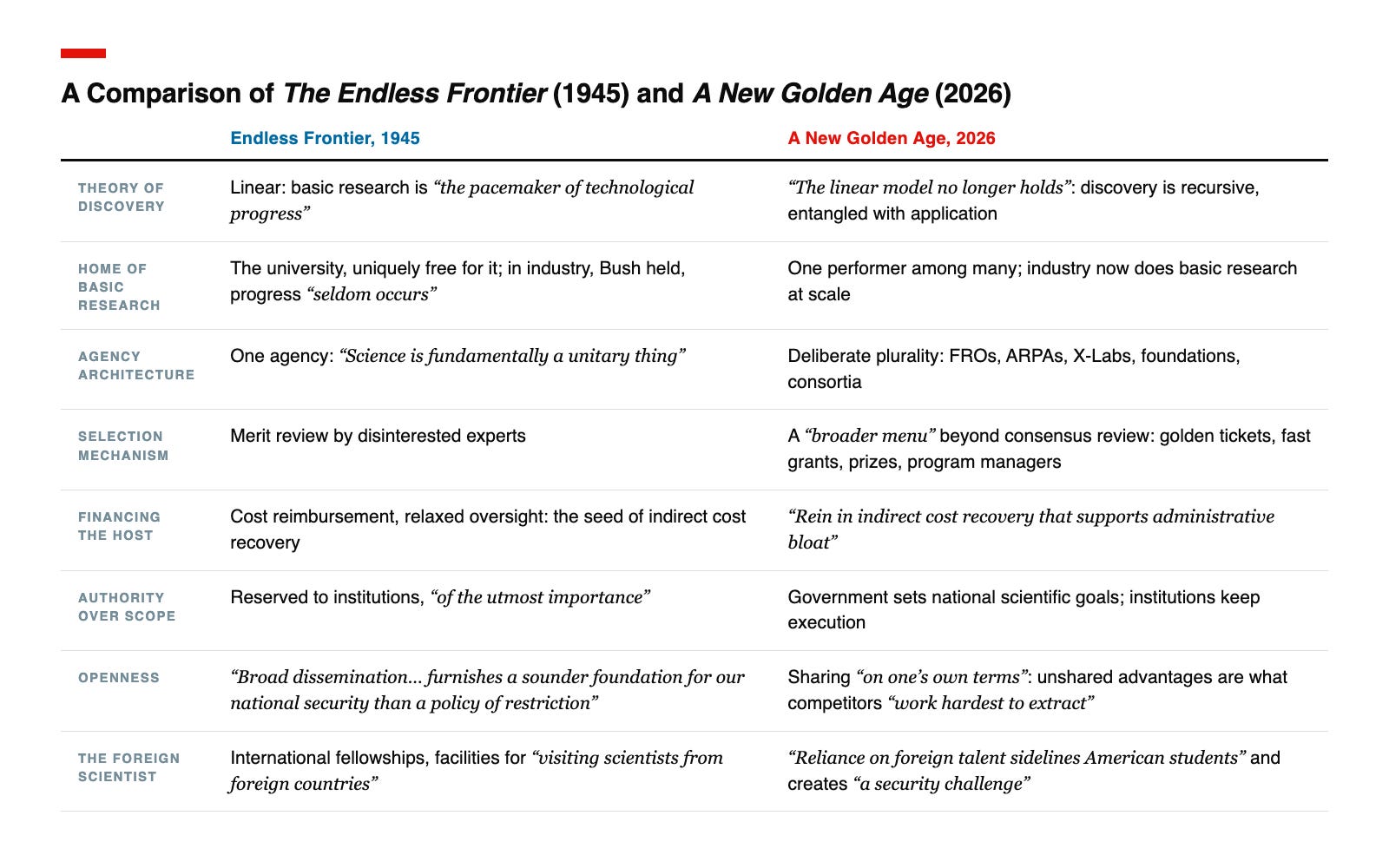
The Endless Frontier and A New Golden Age do agree on a bedrock principle:
Government must fund what markets will not.
Bush’s claim that research is “likely to be cultivated inadequately if left without more support than will come from private sources” parallels A New Golden Age’s claim that “not all valuable research attracts private capital.”
But read down the table and it’s clear they are different operating systems:
The Stakes: The World Bush Built
One more thing must be said: This is not, strictly, an American story.
America’s Global Scientific Leadership
The Endless Frontier became the template for the postwar world’s entire scientific order: science as a global public good, openly published, internationally staffed, with the United States as its anchor tenant, its magnet for talent, and the chief beneficiary of the trust the arrangement earned.
American science diplomacy, the influx of global talent that Nature reports the whole system has come to rely on: all of this is downstream of choices the 1945 report made about openness and exchange.
The United States led global science because the world’s scientists made it their capitol, and they made it their capitol because the system was open.
All of this is up for grabs.
A False Choice Few Americans Support
A New Golden Age proposes, without quite saying so, to end that order and replace it with another: science as a national asset, invested in and protected, its benefits accruing “to the American people first,” its openness governed by the logic of the National Security Strategy it invokes, which frames technological capability as the ground on which all other national power now operates.
On the question of global talent, the strategy does not hedge:
“At the same time, we cannot allow meritocracy to be used as a justification to open America’s labor market to the world in the name of finding ‘global talent’ that undercuts American workers. In our every principle and action, America and Americans must always come first.”
This presents a false choice: either protect American workers and national security or remain open to global scientific talent, ignoring substantial evidence of the significant “spillover effects” of high-skilled immigration and innovation.
And the NSS stance reflects a view few Americans hold:
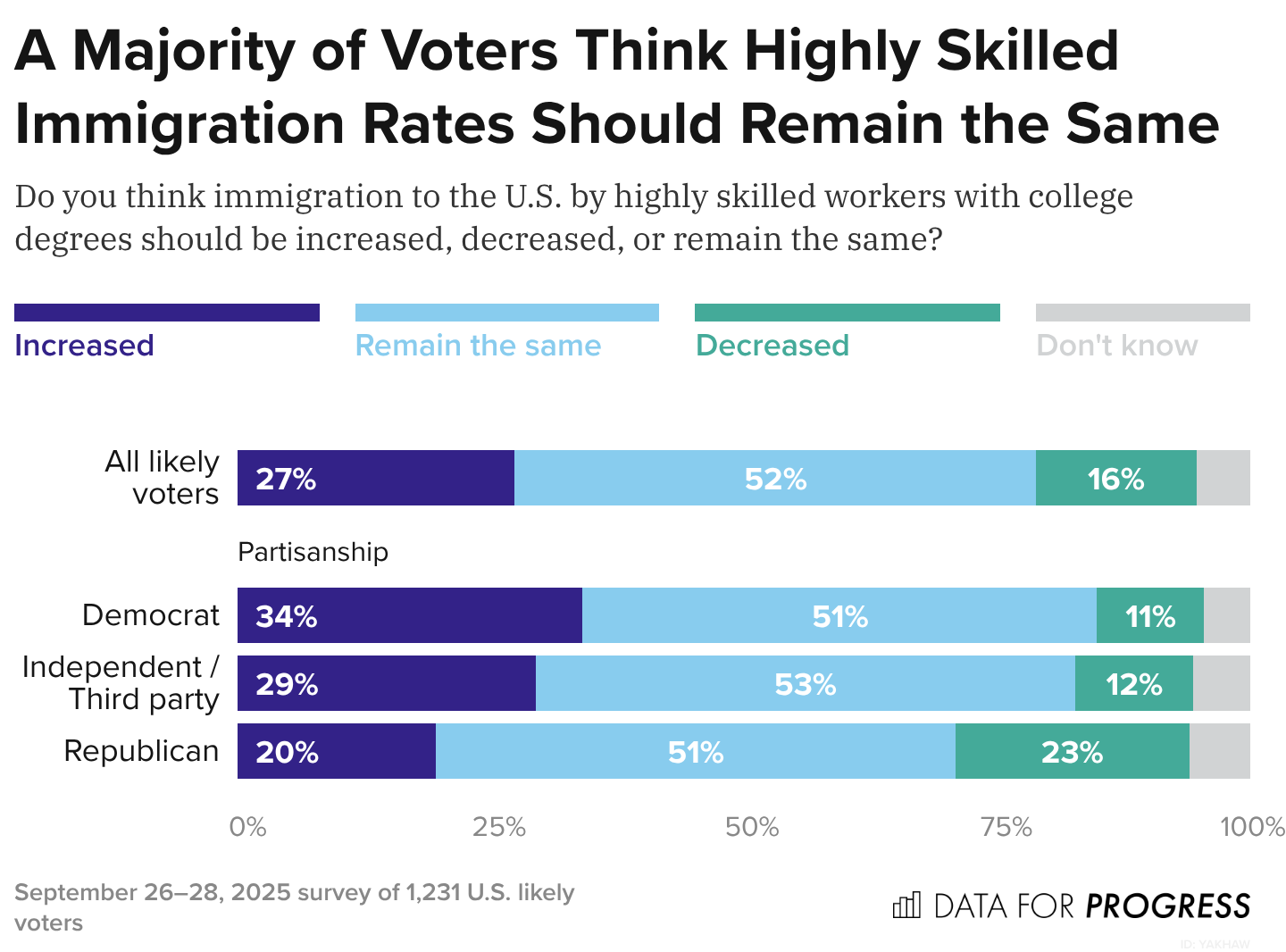
In a Data for Progress survey of likely voters last fall, only 16 percent wanted highly skilled immigration decreased; 79 percent wanted it kept the same or increased. Among Republicans the figure was 71 percent.
The United States led global science because the world’s scientists made it their capital, and they made it their capital because the system was open.
In Times Higher Education last year, Hans de Wit, Philip Altbach, and I asked: Who fills the void when the US turns away from global science? and the deeper risk is a research world that “becomes more Balkanised, with collaboration siloed into competing geopolitical blocs.”

The deepest irony for future historians would be: in the name of winning a race with a centralized, state-directed scientific power, America dismantled the openness that was its actual advantage.
The counterfactual question is what America gives up when it chooses restrictionist policies over targeted reform: whether whatever security gained is worth sacrificing the pull that brings the world’s talent to America and the trust that makes America the place where the world’s science is built.
For a document that thinks with the acumen of an investor, it has strangely little to say about downside risk.
History Will Have the Final Word
By now you have found my reading too generous, too harsh, or maybe just right.
Either verdict is acceptable.
My aim is the recognition that A New Golden Age marks a rare inflection point in how a great power organizes the production of knowledge, and it deserves our full attention.
The parallels between A New Golden Age and The Endless Frontier are impossible to miss.
Who would not want a “new golden age”?
The phrase is difficult to argue with, which is precisely why I hope it generates real debate.
Shifts of this scale are judged only in hindsight.
History’s sample is small, not silent:
Systems that chose their questions centrally have, again and again, been out-discovered by systems that let questions choose themselves.
The report sets its own “simple measure of success”
“A decade from now, American researchers should look back at our work and say: ‘The vital questions I could not pursue then, I am free to pursue now.’"
80 years ago a report to the President made a wager on freedom and won.
A New Golden Age makes a similar, high-stakes wager. As it argues:
“The shape of an institution determines the shape of the science it produces.”
Future generations will judge it by the standard it has set for itself and by whether the institutions it builds expand or constrain the freedom to pursue humanity’s vital questions.
What are your thoughts on Science: A New Golden Age?
Share your comments below. n the spirit of Daniel Dennett’s rational approach: What does it get right? What does it miss? Science policy improves through good-faith disagreement and the willingness to revise our views when the evidence warrants it.