

OPT for the Future
5 Million Records, a Shifting Labor Market, and the Case for Reforming OPT

OPT was designed in 1992 as a short-term training bridge, in an American economy entering its longest peacetime expansion. It was expanded in 2008 to retain STEM graduates during the rise of Big Tech, and again in 2016 as global competition for talent intensified. Each version was designed for the labor market of its era. None of them were designed for the one we are entering.
That’s the context missing from the current fight over OPT.
In March, the Keep Innovators in America Act was introduced to codify OPT in legislation. Simultaneously, legislators are pressuring the White House to dismantle it, arguing the program is unlawful and displaces American STEM workers. DHS is expected to publish a proposed rule in the coming weeks (although it’s taken longer than expected) and has confirmed it is re-reviewing OPT, citing concerns over US worker displacement, fraud, national security and federal oversight of the program.
I analyzed 5.6 million records from the 2022 OPT Observatory dataset to see what’s working and what’s broken.
Critics cite real, powerful accounts of native worker displacement; advocates highlight evidence of aggregate economic benefits.
The choice between eliminating and protecting OPT treats it as a single, coherent program. The data show it isn’t.
What I found convinced me:
OPT must be designed for the future.
Not just because the program has outgrown its original rationale, but because the labor market it feeds into (once again) is being restructured by technology, reshaped by geopolitics, and strained by a structural contraction in entry-level hiring that is hitting American college graduates.
A Brief History of OPT
Optional Practical Training (OPT) was designed in 1992 as a training bridge.
The name suggests a program that is “optional”. If that’s the case, it’s an option 66% of doctoral students, 59% of master’s students and just under half of bachelor’s students took advantage of in 2022.
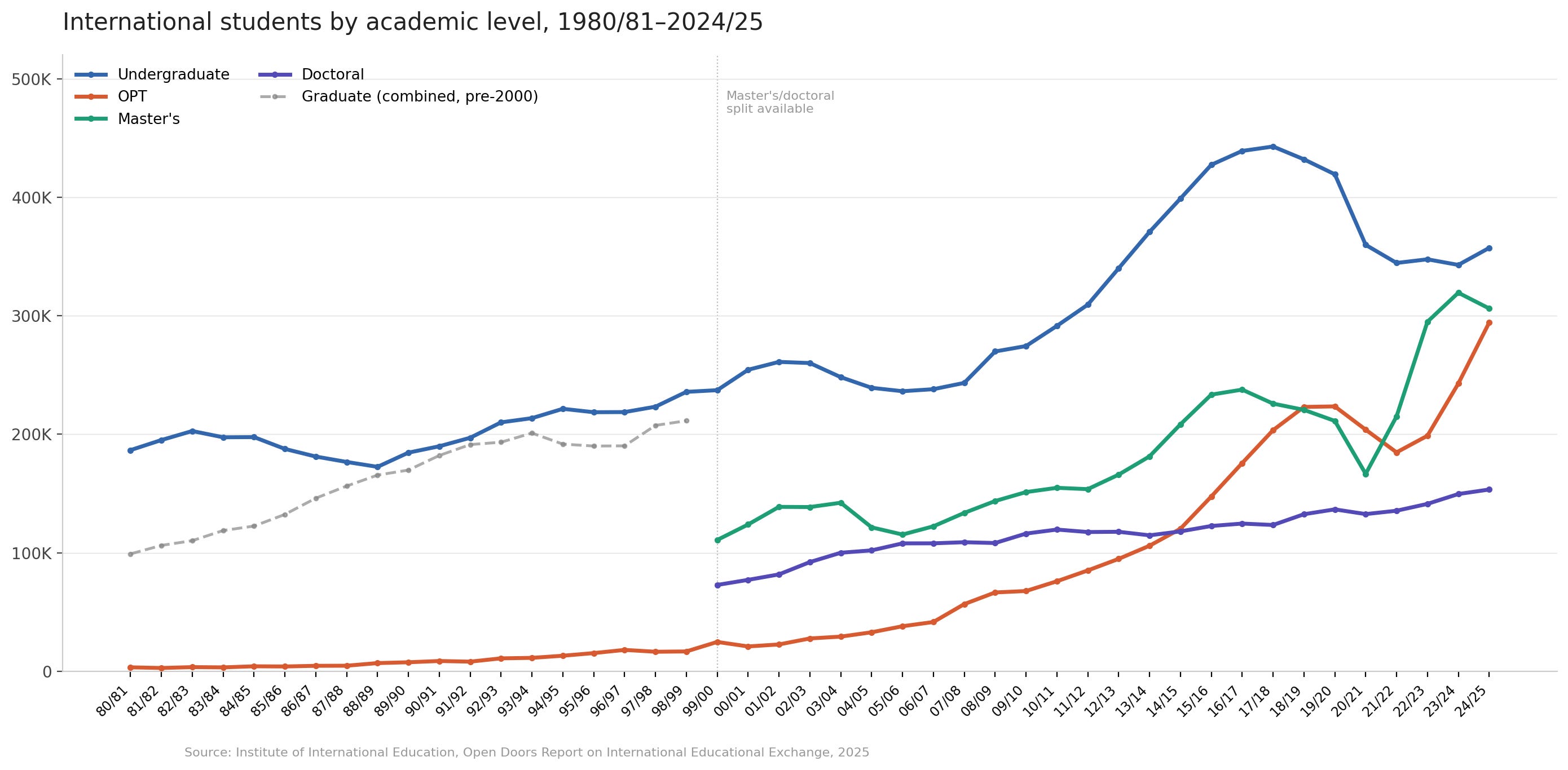
OPT’s growth as a share of the total international student population rose from roughly 1% in 1980 to 4% by 2000 to 25% by 2025.
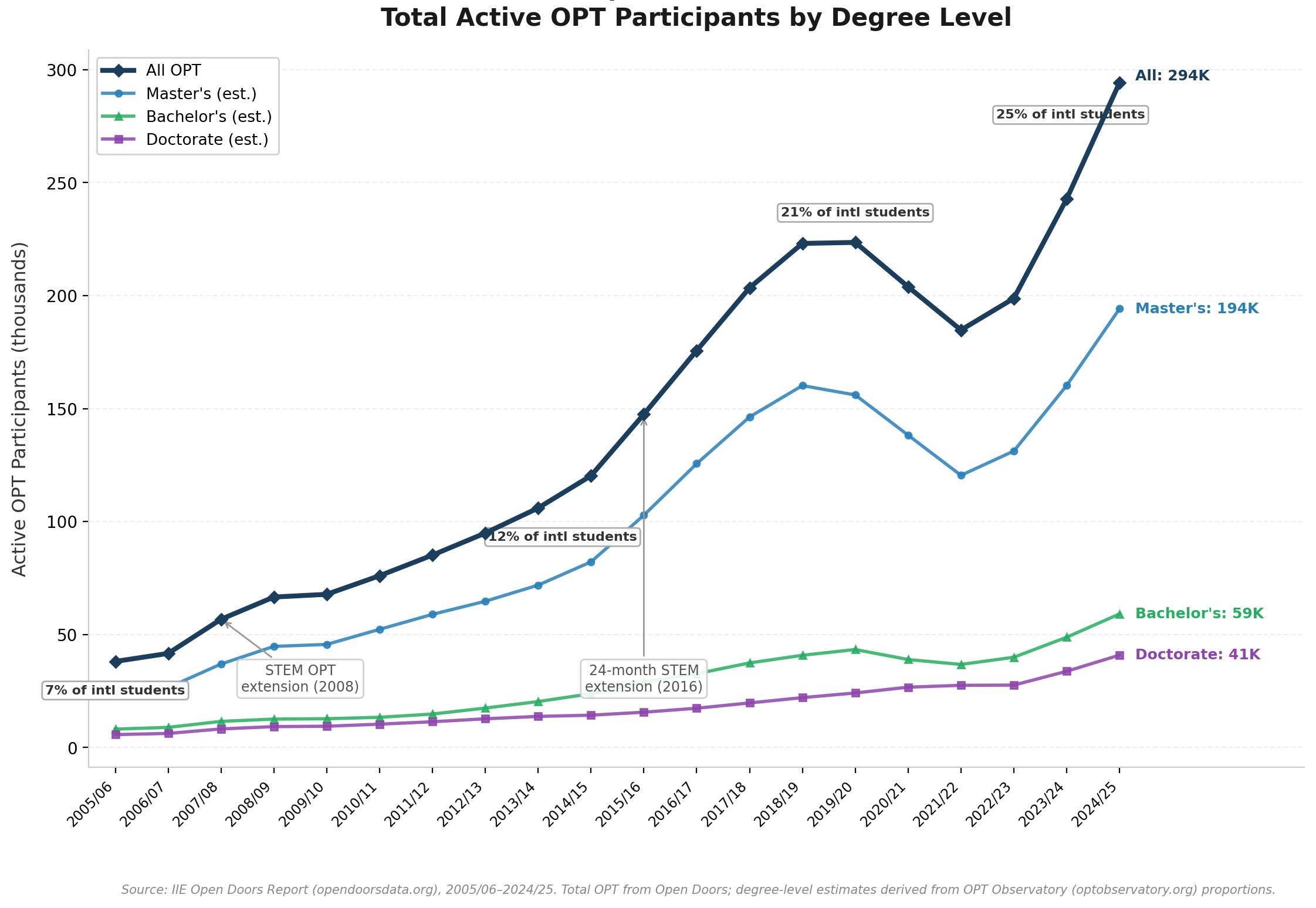
Participation in OPT has more than doubled (+145%) over the past 10 years from 120,287 (2014/15) to 294,253 (2024/25). For proponents, growth is a sign of success. For opponents, it’s cause for concern.
Look at the orange line in the graph below:
As the chart below shows, most of the growth has occurred at the master's level as universities have expanded master’s degree programs over the past 20 years with much of the master’s international enrollment driven by students from India.
OPT is intended to be “practical training” that complements a student’s education.
But OPT is not “optional” for a majority of international graduate students.
A NAFSA/IFP survey of 1,600 international graduate students and postdocs found that 54% would not have enrolled in a U.S. program if OPT had been unavailable. The deterrence effect is sharpest among those who currently intend to stay in the U.S.: 70% of master's students, 64% of PhD students, and 45% of postdocs said they would have foregone enrollment entirely.
70% of students whose top preference is the US now report considering multiple destinations.
What Do 5 Million Records Tell Us?
I’ve spent the past several weeks analyzing OPT Observatory data, poring over millions of SEVIS employment authorization records from 2022 (the most recent data available, covering 1,969 universities and 319,203 employers).
The data tells a more nuanced story than OPT’s critics and defenders suggest.
Critics argue that OPT is a Big Tech subsidy, but the 2022 data indicate that 88% of placements occur outside the top 100 companies. And the big FAANG companies (Amazon, Google, Microsoft, Meta, Apple, Intel, and Nvidia) make up only 5% of the authorizations. Plus, Google hired from 318 universities across 46 states. Microsoft drew from 350 universities across 44 states.
The employer backbone of OPT is real and distributed. The median employer hires 3 OPT graduates. That said, employment at some firms is probably higher than the headline number suggests when they hired from staffing intermediaries.
The program works better than its critics claim. But it also has some warts that its defenders overlook.
A small, but significant, number of universities show low-quality signals in their OPT authorizations: staffing intermediary placement, immediate CPT with full-time work from day one, 90%+ single-country concentration, top employers all staffing firms, <1% in-state employment.
So let’s look at what we can learn about universities as gateways to OPT.
5 Pathways and 1 Backdoor
I measured characteristics to assess institutions, covering placement destinations, student origin patterns, and authorization behavior.
Hierarchical cluster analysis on these characteristics produced six structurally distinct institutional models: 5 pathways and 1 backdoor.
Five Pathways…
Type 1: Research Career Pathways
OPT here is research continuation, not job placement. Nearly 10% of graduates stay employed at their own institution as postdocs, research associates, and teaching faculty, and over a quarter work in the education sector broadly. Doctoral students make up over 50% of enrollees of these institutions, the highest of any type. CPT rates are the lowest of any cluster. These are land-grant research universities and state flagships where international students enter PhD programs, conduct original research, and transition into academic or national laboratory careers through the same institutional relationships that trained them. About 67 institutions, 63,000 students (5%) fit this profile.
Type 2: Professional Practice Pathways
OPT here is a required professional field placement, not employment in the conventional sense. Clinical rotations in hospitals, veterinary field placements, agricultural research practica — the practical experience is a degree requirement, not a separate career step. 75% of graduates work in the same state as the school, reflecting regional professional labor markets (healthcare systems, agricultural extension networks) rather than national talent flows. These are health sciences universities, land-grant institutions with strong agricultural programs, and mid-tier research universities with specialized professional schools. Unlike Type 1, students leave the institution for practice settings but contribute to state and local economies. About 70 institutions, 34,000 students (3%) fit this profile.
Type 3: Undergraduate Colleges
The traditional international student experience. Three-quarters of students are undergraduates (the highest share of any type) pursuing bachelor’s degrees at liberal arts colleges, mid-size state universities, arts conservatories, and religiously affiliated colleges. Country-of-origin is far more diverse at these institutions than (no single country exceeds 25%). Staffing firm involvement is minimal. Tech sector placement is low. Most students return home after graduation, treating OPT as brief practical experience rather than a U.S. career launch. About 427 institutions, 171,000 students (14%) fit this profile.
Type 4: Elite Talent Pathways
OPT at elite institutions functions less as training and more as talent retention. Ivy League universities, flagship Big Ten campuses, and University of California system schools produce graduates who move directly into Big Four consulting, top finance firms, and major tech through on-campus recruiting pipelines that connect top-tier institutions to top-tier employers. About 136 institutions, 376,000 students (31%) fit this profile
Type 5: STEM Masters Pipelines
The largest cluster by volume and the primary engine of U.S. tech talent supply. Major engineering universities, large innovation-oriented research universities, co-op focused schools run high-throughput masters programs in CS, electrical engineering, business analytics, and data science that feed directly into tech industry hiring. These institutions have the highest major tech company placement rate of any type and the highest H-1B sponsorship rate. OPT is the first step of a career pathway as the STEM extension intended. About 153 institutions, 385,000 students (32%) fit this profile.
…One Backdoor
While I found five legitimate pathways; I also uncovered one backdoor.
Type 0: Credential-Based Backdoor
Less selective regional publics, small private colleges, and some for-profit institutions whose core domestic enrollment is shrinking and whose international enrollment has become a revenue lifeline. Here, staffing firm placement is 3x the average. About 110 institutions, 173,000 students (14%) fit this profile.
Staffing firm placement 3x the average (top employers are staffing firms)
Employment 500+ miles from campus in known staffing hubs
Single-country concentration >70%
IT/CS concentration >45% regardless of institutional academic strengths
At the most extreme Type 0 institutions, more than 60% of international students carry CPT records — nearly triple the overall rate, and unlike OPT, CPT is authorized during enrollment under a separate statutory provision.
If you use the OPT Observatory interactive tool online, you will see examples of institutions that had barely any students on OPT until the 2016 STEM Extension, then suddenly they shot up to several hundred per year, with some skyrocketing from 100s to a few thousand per year — a 3-5x increase!
So is OPT Training, Talent, or Arbitrage?
So, is OPT short-term training program, a high-skilled talent pathway, or credential arbitrage?
The honest answer is “all of the above”, but in different proportions, at different institutions.
A significant number students use OPT as it was originally conceptualized in the 1990s — a short-term training program. They earn degrees, gain practical experience in their field, then either return home with American know-how.
An increasing number of students use it as a “front door” for high-skilled talent pathways, reflecting the intent of the STEM extensions in the 2008 and 2016.
A small but significant number of students now arbitrage the gap between the program’s training rationale and its employment function, reflecting concerns from an increasingly diverse set of critics in the 2020s.
The program’s critics are describing something real. So are its defenders. They’re just describing different realities of the same program.
Forward-looking policy demands OPT be updated for new labor market realities.
The Post-2022 Entry-Level Hiring Wrench
But here’s the catch: the OPT data I analyzed was from 2022.
It’s the most recent available, since accessing it requires a FOIA request through the Institute for Progress’s OPT Observatory.
But since 2022, entry-level hiring has fallen off a cliff for American college graduates. International students are feeling it too: more are closing OPT records early, unable to find employment in the fields they trained for—particularly graduates of low-quality programs optimized to benefit institutions desperate for revenue, not for students seeking workforce opportunities.
In the data I analyzed, computer science and related fields accounted for roughly 31% of all OPT authorizations. The staffing pipeline population concentrates even harder, with 74% in IT and CS, disproportionately feeding lower-productivity firms, not pipelines for tech founders or future Nobel laureates.
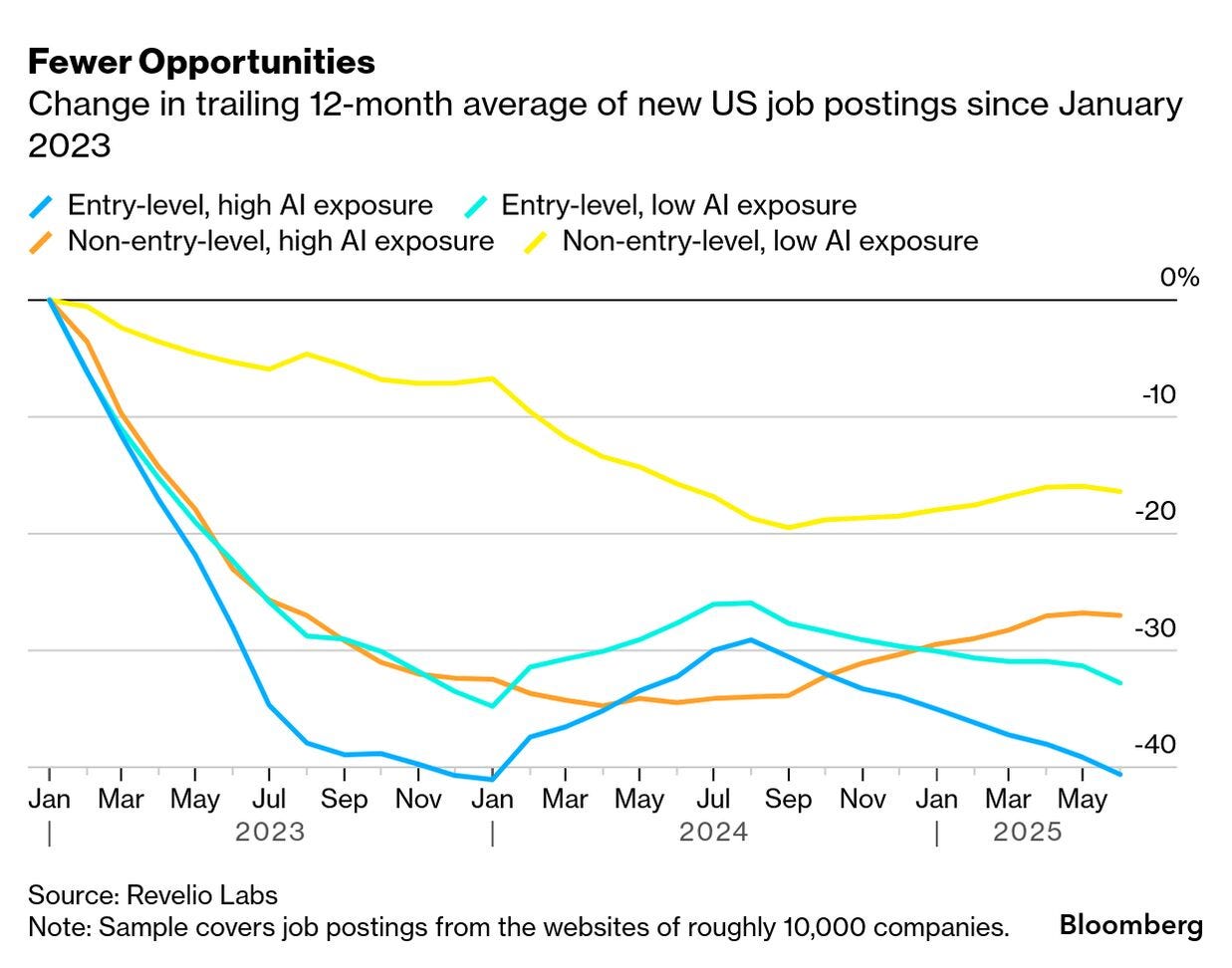
Entry-level tech hiring dropped roughly 25% between 2023 and 2024. More alarmingly, a recent Stanford Digital Economy Lab study found a 16% relative employment decline for workers aged 22 to 25 in AI-exposed occupations, a drop that persists even after controlling for firm-level macroeconomic shocks.
Entry-level hiring at big tech companies has plummeted compared to pre-pandemic levels, with estimates suggesting only 7% of 2024 new hires were recent graduates. Consider Microsoft: even as it prepared to cut 15,000 jobs in 2025, the company filed labor applications to bring in almost 10,000 new foreign workers. Bad optics at best. Firm-level displacement at worst.
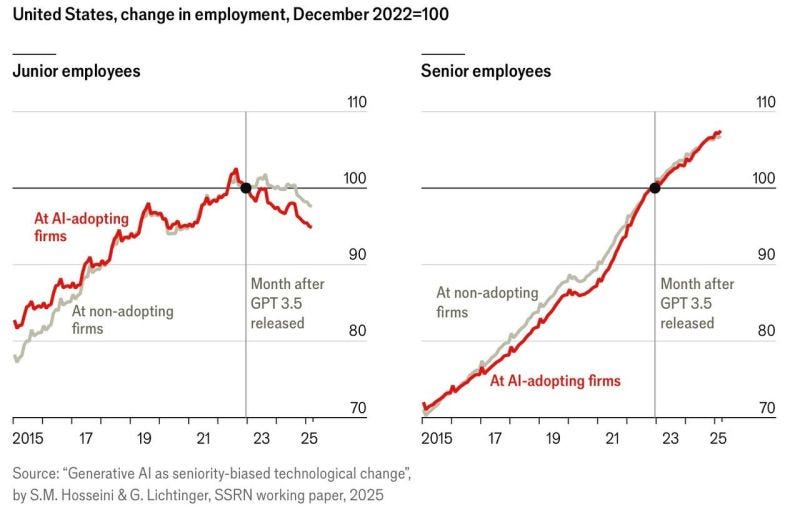
It is entirely possible that some of these declines are cyclical. The 2023–2025 entry-level contraction coincided with an interest rate shock, a post-pandemic tech spending correction, and mass layoffs that hit workers across the board.
Indeed, recent data suggests a Jevons Paradox-style rebound in sectors like software engineering, with job postings ticking back up as companies consume more code to build increasingly complex infrastructure.
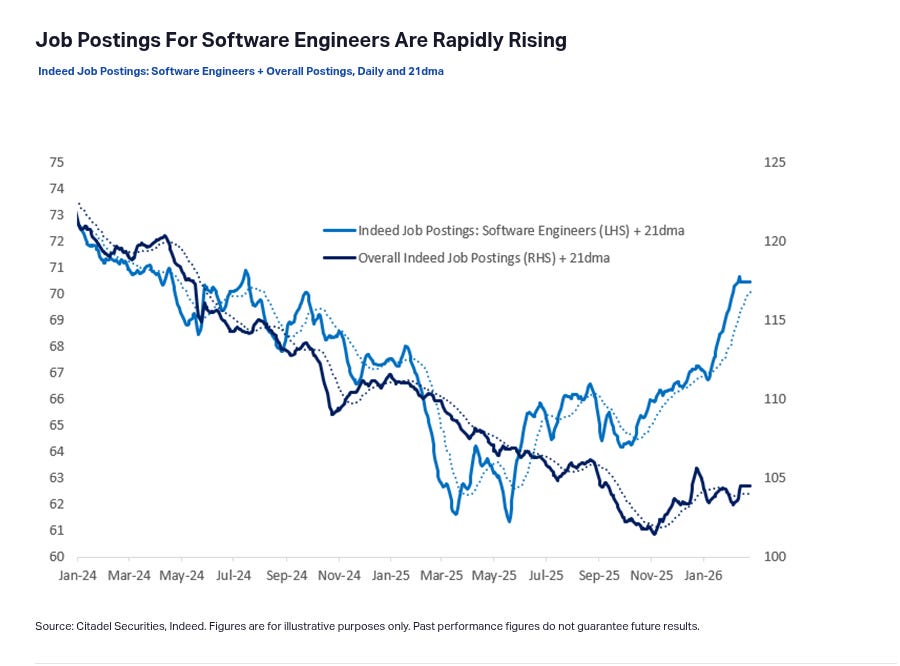
But while it is tempting to write this off as a cyclical dip, the macroeconomic data suggests a profound structural shift.
Recent analysis from the Federal Reserve Bank of Cleveland found technical change may no longer favor college graduates the way it once did. The disproportionate rise in productivity among college-educated workers (the engine that drove the college wage premium through in the last century) has plateaued since 2000. If that trend holds, the growing supply of college-educated workers will push the premium down further, not up.
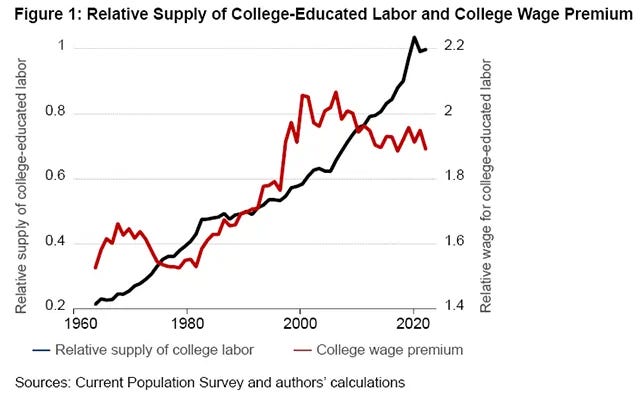
The New York Fed’s “The Labor Market for Recent College Graduates” tells a consistent story.
Technical change may no longer favor U.S. college graduates the way it once did. OPT, especially the STEM extensions that now define it, was built on the opposite assumption. That doesn’t make the program obsolete. It means OPT needs to be designed for the future.
In a tightening labor market, entry-level U.S. college graduates in AI-exposed fields face a structural vulnerability at the firm level (a dynamic that aggregate economic arguments often overlook).
Senator Mark Warner (D-VA) recently reiterated his belief that AI will severely disrupt the labor market for new college graduates in a Axios AI Summit and Hill & Valley Forum panel discussion, saying he would “bet anybody in the audience that [unemployment for new college graduates] goes to 30 or 35% before 2028.”

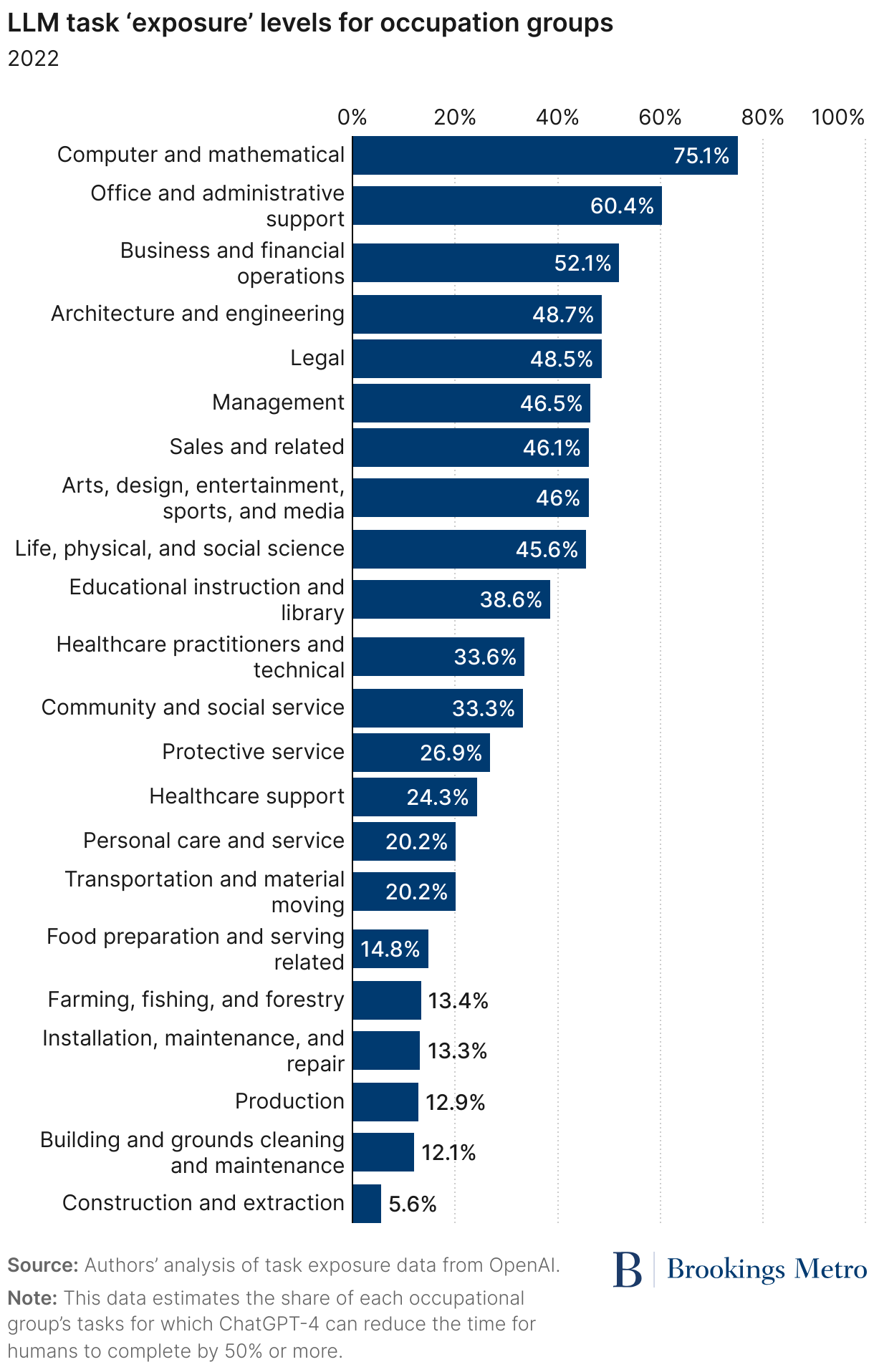
Analysis from Brookings highlights how the tasks that large language models handle competently—synthesis, basic coding, and first-draft generation—map directly onto entry-level knowledge work and concentrates in top majors for international students, including computer science and business analytics.
So, Who Gets Displaced — and Where?
The closest evidence on how foreign workers affect native employment at the firm level comes from a 2024 quasi-experiment on H-1B workers by the Federal Reserve Bank of Richmond.
The study found that firm productivity determines the direction of the employment effect, not just its magnitude.
High-productivity, skill-intensive firms that win H-1B lotteries expand their operations and pull native workers up with them.
Lower-productivity firms show the opposite: substitution. And the workers most substitutable with high-skilled immigrants at those firms are specifically high-tenure, young, native college graduates.
This complicates both “populist” and “establishment” narratives. Yes, H-1B and OPT are different programs, but no study of comparable methodological rigor exists for OPT specifically and the underlying labor market dynamics are relevant.
For OPT’s critics, uniform restriction would hurt high-productivity firms most, produce uncertain gains for the workers it aims to protect, and risk American technological dominance.
For OPT’s defenders, one of the most rigorous studies of foreign workers’ impact on native employment finds real substitution effects at lower-productivity firms.
The polarizing debate treats the choice as a verdict on the virtues or sins of America’s past. The real question is whether OPT can once again be redesigned for the labor market of the future.
And Don’t Forget China
The urgency for US policymakers to develop a coherent national strategy for high-skilled talent comes from the latest Nature Research institution rankings.
Here’s a screenshot:
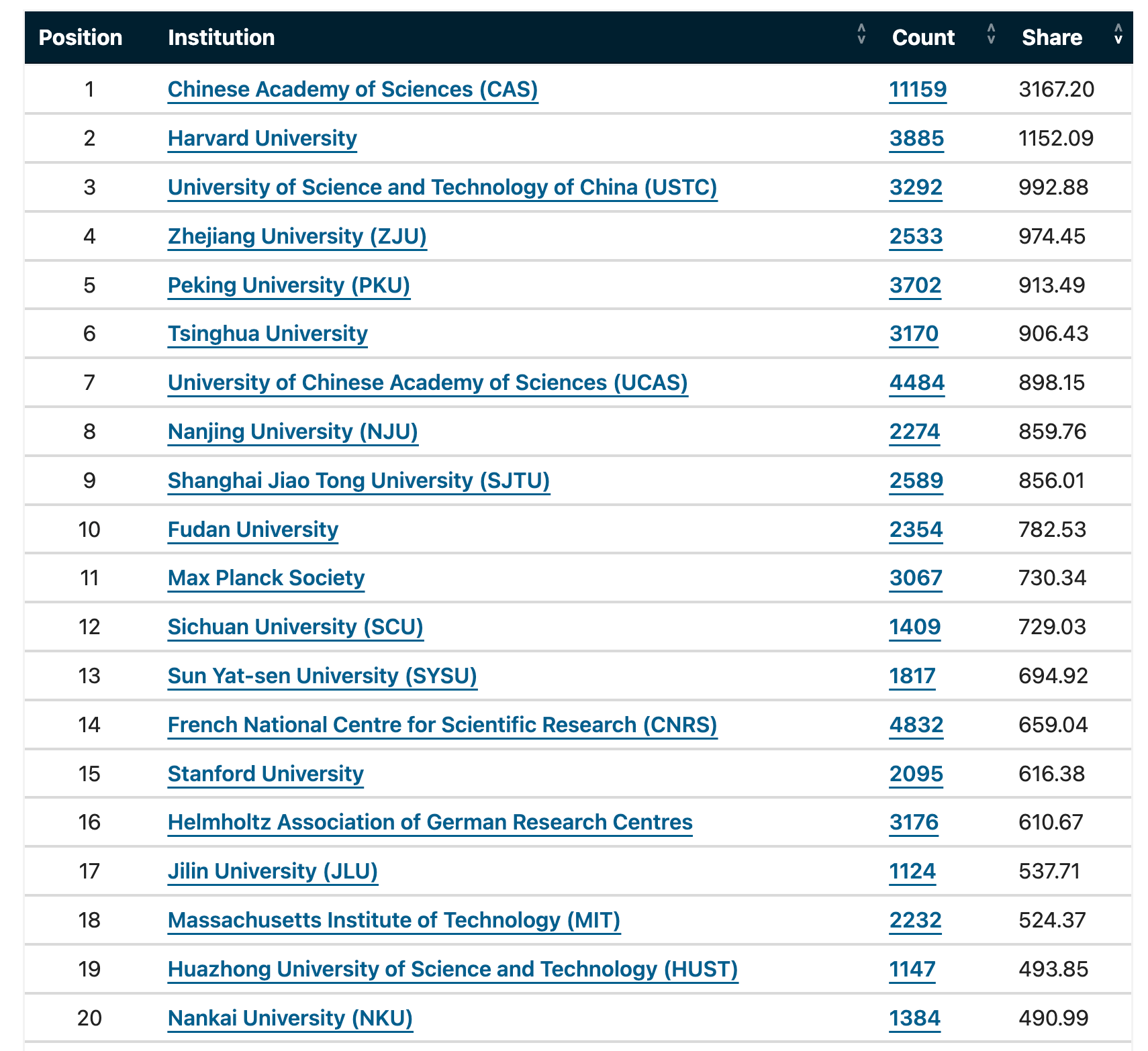
Harvard, MIT, and Stanford are all in the Top 20, but so are 14 universities from China, 2 from Germany, and 1 from France.
China’s scientific rise changes the baseline from which U.S. policymakers should avoid the false choices of current OPT debates.
As Nature’s 2025 analysis demonstrates: the relevant counterfactual is no longer a world in which talented graduates have nowhere else to go.
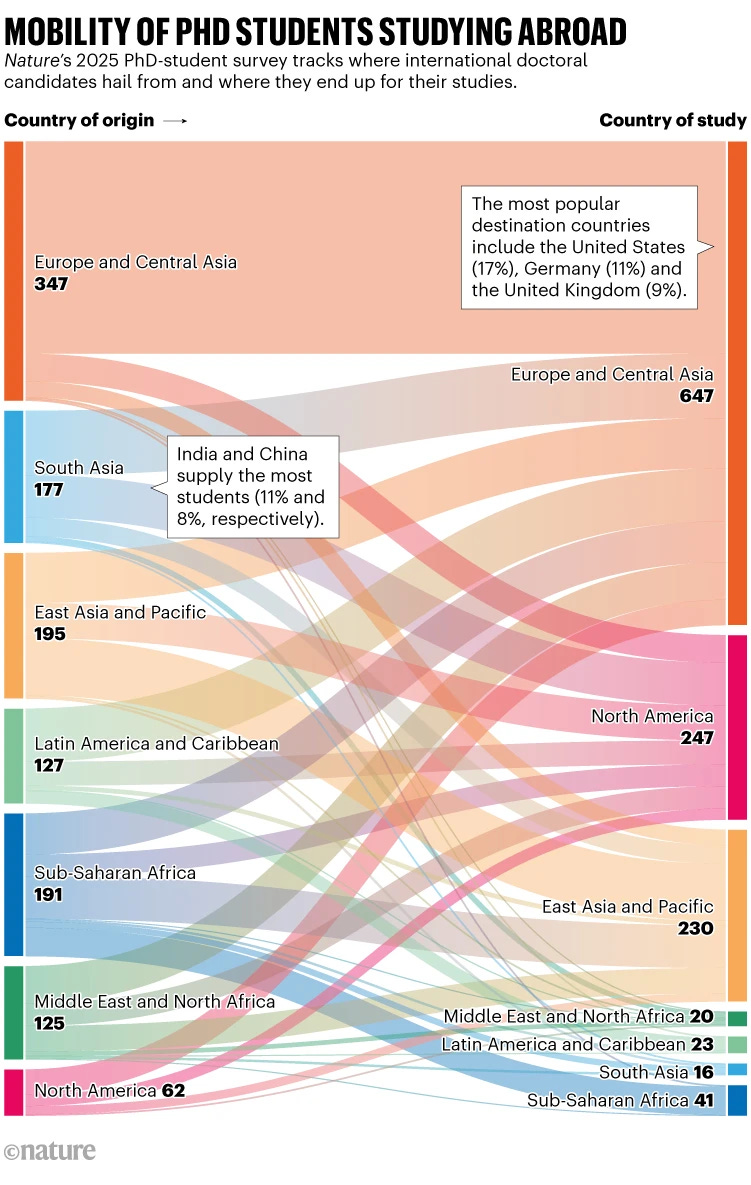
And the strategic competition between the US and China is real.
For a techno-realist perspective on China’s rise as a scientific superpower, I recommend reading China and the Future of Science.
China is technologically ambitious, scaling STEM training, expanding advanced research infrastructure, and improving incentives for scientists trained abroad to return home. As I argued in the Washington Post, “The assumption that top researchers will endure any visa hardship to stay in the U.S. is obsolete.”
For policymakers on all sides, the analytical burden is the same:
Specify the conditions under which OPT strengthens U.S. capacity, and those under which it merely subsidizes human-capital transfer to other research systems. Without reform, the greatest talent arbitrage in the world today may be the one the United States runs against itself.
Smart Reforms for the Future
Some ideas policymakers are weighing that I believe have merit:
Close the FICA gap.
OPT workers are exempt from Social Security and Medicare taxes — a 7.65% employer cost advantage that follows from tax classification, not deliberate policy. When a “training” program authorizes three years of employment, the short-term visitor tax treatment no longer fits. Remove it. The Institute for Progress estimates closing this exemption would raise $27–$36 billion in federal revenue over ten years.
Create a research-role carve-out.
Five years of authorization for university-based research roles — postdocs, research scientists, lab leadership — matches what peer countries already offer and targets the population the US can least afford to lose. There is where Congress can act to retain talent where America’s research universities continue to lead the world in science.
Cap staffing-intermediary placement and audit institutional outliers.
SEVP already holds the data to identify institutions where OPT functions less as training and more as credential arbitrage. Institutions that consistently exhibit these patterns should face conditional recertification, with continued access to OPT tied to measurable placement outcomes. No institution should function primarily as a credential that unlocks work authorization.
These reforms close the structural advantages that make OPT exploitable while redirecting the pipeline toward the talent tiers where international graduates and American strategic interests converge.
OPT For The Future
The National Academies has argued the urgency of a whole of government talent strategy. Higher education is the primary ‘front door’ for U.S. high-skill STEM immigrants to enter the U.S. workforce. And OPT is its threshold.
What works is what has always worked in American economic policy at its best: see the shift, fix what’s broken, build for what’s coming.
The United States did not become the world’s scientific leader by accident. It became one by building institutions that attracted the most ambitious people on Earth and gave them reasons to stay.
That advantage is not permanent. It is a policy choice.