

Hope Through Data
Reclaiming Agency in International Education


My Substack has a fresh new look! Check out the mini-series from 2025. I’ll continue to offer data-driven, non-partisan, future-forward analysis in 2026. Thanks for subscribing!
The French economist Frédéric Bastiat wrote in 1850 that the difference between a bad economist and a good one is simply this:
The bad economist confines themselves to “what is seen” while the good economist takes into account what “must be foreseen.”
That distinction, between the seen and the unseen, runs through nearly every moment of technological and political disruption in modern history. And it is the discipline this moment demands.
The way forward demands hope through data.
That’s the argument I made at the Association of International Education Administrators (AIEA) closing plenary last week, alongside Lynn Pasquerella of AAC&U and Ben Webb of QS in a panel moderated by Karin Fischer of The Chronicle of Higher Education.

Together, we explored three perspectives that I will unpack below:
labor markets and policy,
global demand and institutional strategy, and
democratic foundations and community engagement.
What is Hope?
I want to be precise about what I mean by “hope”, because it’s a word that loses its power if you’re not careful about how you define it.
Hope is not looking away. It comes from looking more closely than anyone else, at evidence that reveals not just what is breaking but what is becoming possible.
Hope is not optimism. Optimism is wishful thinking that things will just work out. It requires no effort and no evidence. It’s often a way of not looking closely.
My view of “hope” is grounded in what the philosopher Richard Rorty called social hope. Rorty drew a distinction that has stayed with me: social hope isn’t the conviction that history bends toward justice on its own. It’s the harder thing, the pragmatic commitment to imagining and building better institutions and better futures, even when the outcome of our effort is not guaranteed.
What makes Rorty’s version different is what it requires of us.
Social hope starts by facing hard truths. It means admitting where your critics have a point. It means letting go of comforting stories that have offered solace in the past. Social hope expands our collective capacity to see the world through other people’s experiences and to imagine arrangements that don’t yet exist.
Rorty’s expansion of our moral imagination is exactly what building the future demands, the hard work the headlines distract us from.
So when I say “hope through data”, I mean something specific: the disciplined commitment to seeing both the seen and what must be foreseen.
Hope demands we grieve what’s being lost and what the disruption is making possible. Not one or the other. Both, simultaneously, with evidence.
It’s not a feeling. It requires discipline. And data is its foundation.
A Framework for Hope
Throughout the past year, I’ve been testing a framework with policymakers: on Capitol Hill, at a debate at MIT, in conversations that cross every party line. It maps the current moment along two dimensions: evidence versus narrative on one axis, and populist versus establishment perspectives on the other.
A simple “myth vs. fact” approach is too binary. Both establishment and populist voices operate with their own sets of myths, facts, fictions, and half-truths.
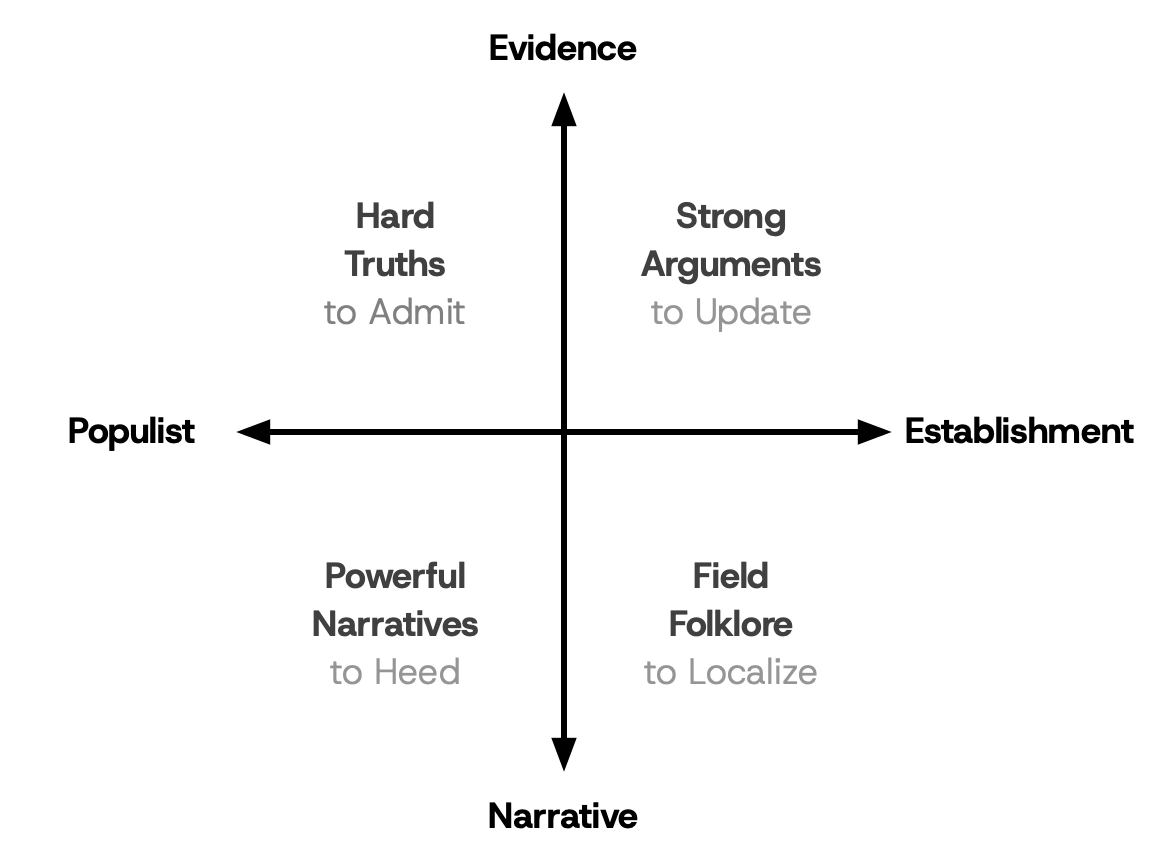
Social hope requires credibility. Credibility wins arguments. And credibility requires working in all four quadrants simultaneously.
Hard Truths – To Admit
Let’s start with hard truths. It’s where strong evidence supports what populists point out. It’s what the field often discounts or tends to overlook. If we can’t say hard truths out loud, we will lose our credibility to say anything else.
Hope starts here.
We cannot fear that publicly ceding these points compromises our mission—when, in fact, it’s how we live it out.
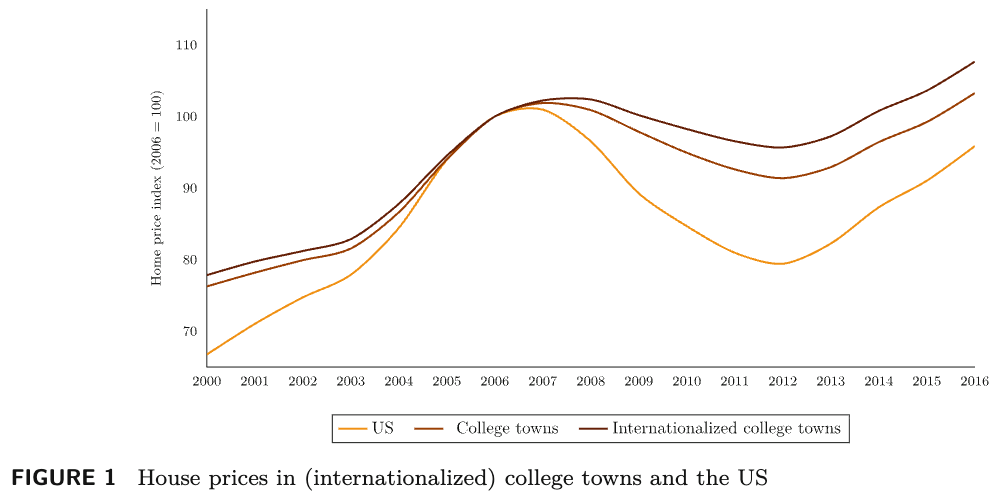
Some American universities have compromised their core values of academic freedom and free speech to appease foreign authoritarian regimes in exchange for financial support and partnerships. While international students “create seats” for native students at most universities; elite STEM programs show zero-sum dynamics. The influx of international students in certain metro areas have increased the cost of housing. China’s “military-civil fusion” is a significant concern for U.S. national security.
In 2025, Microsoft laid-off 15,000 workers; at the same time it certified 14,181 foreign worker positions. Even though Microsoft pushed back against the argument that it was one-for-one, Department of Labor data indicates it brought on 9,738 new foreign workers as it initiated the layoff.
The evidence points to “complementarity in the aggregate” and “displacement in specific sectors/metros/firms” simultaneously. The field points to the aggregate benefits but ignores the distributional costs. High-skilled immigration is a net-positive on GDP and corporate profits in the aggregate, but flooding a metro job market with foreign students and H-1B workers suppresses wages and crowds out native-born workers. Displacement is real at the firm level and in specific sectors like CS and accounting. Expansion of foreign STEM workers caused Black male students to move away from STEM majors (−34% relative to baseline) and white male STEM graduates to shift out of STEM occupations. Immigration reduced STEM wages by 4–12% relative to non-STEM; there is significant heterogeneity based on the proportion of competing and non-competing immigrants by major.
If you are still reading, rather than scrolling to the comments to fire-off a reply, thank you. Even if you think I’ve gone too far, thank you for being open-minded enough to consider evidence that challenges the field’s dominant narrative of the incontrovertible benefits of internationalization. We need more wrestling with these realities. If the major associations continue to champion the aggregate benefits while ignoring the distributional costs, they will undermine their credibility to be at the table in policy reform efforts designed to address them.
Powerful Narratives – To Heed
Powerful narratives are where populist stories move politics with rhetoric that treats anecdote as proof. These narratives draw their power from the seen: the visible disruption, the worker whose job has vanished, skyrocketing housing costs, the concrete loss. And the field’s instinct, nearly every time, is to respond with aggregate data. That instinct is wrong—not because the evidence is not “on our side”, but because few ethical systems dismiss the pain of an individual by pointing to a spreadsheet that says “overall, things are fine.”

Alexander Kustov’s book, In Our Interest, clarifies what the field keeps getting wrong about the people on the other side of this argument. After studying attitudes across OECD countries, his finding is striking: most opposition to immigration is not nativism. It is altruism directed at neighbors—a concern that the people in one's own community are being left behind while the benefits of immigration accrue somewhere else.
87% percent of respondents are what Kustov calls “altruistic nationalists”—people who support immigration when they can see, concretely, how it benefits their country and their community.
The problem isn’t that the public is hostile to international students. A recent Pew Research poll indicates 79% of Americans view them positively.
The problem is that the field has been answering a question nobody is asking—Are international students good for the US economy?—while ignoring the question people actually care about: How do they impact my neighbor, here, where we live?

A LinkedIn post from Courtney Brown, VP of Strategic Impact at the Lumina Foundation, went viral during International Education Week, generating 100s of comments and 1000s of reactions. The post cites the oft-quoted NAFSA figure—$43.8 billion in economic contribution, 378,000 jobs supported. The comments exploded. Not with nativism, but with the real stories of workers and families who experienced the costs of immigration without sharing in the gains.
I'm not casting stones. I've made the same arguments. But the comments section (which I typically avoid!) is full of stories that reflect an important truth: a person with an experience is never at the mercy of a person with an argument. The field keeps leading with aggregate numbers and wondering why it isn’t winning over people who have experienced loss.
There’s a lesson in this. Advocate accordingly.
The discipline here is not to abandon data. It is to change which data we lead with. As Kustov urges in his Substack, Popular By Design, rather than assume critics are “anti-immigrant nativists”, assume the best and use data to demonstrate the concrete benefits and local impacts. Talk like a community member, not an economist. Use evidence that speaks to the real experiences and demonstrate openness to listening to the experiences of people who live next door.
Strong Arguments – To Update
Strong Arguments is the quadrant our field loves to live in, for good reason. The evidence is pretty robust. But much of what passes for “strong arguments” are reheated talking points from the 2000s—and reheated talking points work about as well as reheated chicken: tough, chewy, and bland.
Many arguments—soft power, cultural exchange, economic contribution—were built for a different geopolitical era that could count on bipartisan support but no longer exists. New realities require new arguments, not reheated ones.
A 2025 analysis at Stanford highlights the contribution of high-skilled immigration to innovation in the United States.
There are well-documented benefits to American science and innovation. Eliminating OPT would shrink the U.S. STEM Ph.D. workforce up to 11 percent and cost the economy $240–481 billion annually.
The real vulnerability is not that the field undersells the economic case. It is that it defends a broken system instead of demanding a better one.

As I argued in the Washington Post, America’s talent policy still assumes that top researchers will endure any visa lottery or processing delay to stay in the United States. That assumption is obsolete. The geopolitical realities have changed, not just the politics. Nations need new policies for a new era of internationalization.
Evidence for the aggregate benefits of high-skilled immigration is rock solid: consumer welfare (lower prices, more output); innovation output at economy level (patents, startups), and innovation in expanding fields (like AI, where an Institute for Progress analysis found that 66% of the 50 “most promising” U.S.-based AI startups had at least one immigrant founder).
The importance of undergraduate education as a channel for immigrant founders has increased over time. A 2024 analysis from Harvard Business School, indicated 75% of immigrants who founded high-potential VC-backed startups entered the U.S. as international students.
We must argue in counterfactuals—not what international talent contributes, but what it costs when it is lost. As I told Ars Technica last year, the US is on “thin ice” attracting scientific talent compared to countries with strong science and innovation systems (China, Germany, Japan, India, UK, South Korea, Switzerband, and Singapore) according to Nature’s Index of top-performing research universities and countries, as well as the Global Innovation Index 2025.
After World War II, U.S. policymakers grasped a crucial insight: They were investing in people, not just research. The counterfactual question is harder: What happens to American science when tomorrow’s builders stop coming?

As I shared with Nature for a feature on US Science in 2026, the uncertainty is, in many ways, more corrosive than the cuts themselves. When students don’t come to the U.S., they don’t stop studying. They go elsewhere. And like a river, once those talent flows get redirected, they are very difficult to reverse.
The challenge is not persuading the public. A June 2025 Quinnipiac poll found 74 percent of Americans view international students as a good thing for the country. Support is bipartisan—96 percent of Democrats, 75 percent of Independents, and a near-majority of Republicans at 49 percent. Skilled migration is one of the few immigration topics with genuine support across the political spectrum.
The challenge is arguments that converts quiet, broad support into active political capital. The field does not need “better messages”; it needs better ideas for the new geopolitical era, and that means pairing the strong evidence with concrete policy proposals that can actually pass.
Field Folklore – To Localize
Field Folklore is how the field makes meaning, the stories, figures, and examples that circulate within it, sustain its identity, and feel self-evidently true to its members. They aren’t wrong. But they don’t always travel. They resonate at the gatherings like AIEA but may fall flat outside them.
The danger isn’t that they’re false. It’s that they feel true — and often are — yet carry little weight outside the field and even produce the opposite effect than their advocates intend.
Folklore coheres the tribe. It rarely converts the skeptic.
We talk about Nobel Prize winners. Silicon Valley CEOs. World leaders who studied in America. Fine. But trotting out elite success stories to a public worried about local job markets isn’t persuasion. It’s confirmation of the suspicion that international education exists to serve the already powerful.
The $44 billion NAFSA figure is the field’s most reliable go-to — and as Karin Fischer documented in the Chronicle of Higher Education, the economic case for international students has lost its steam. The money flows primarily to major metro areas and college towns, not the communities hollowed out by deindustrialization over the last twenty-five years.

Alan Ruby put it simply: if you don’t live in a hub for international students, the economic argument loses its salience. When a good chunk of the country hears $44 billion, they see money flowing into university coffers, not into the pockets of working families.
Keep telling these stories at gatherings. They belong there. Just don’t mistake them for persuasion. If you’re not sure, try one out on the person next to you at the DMV.
Follow the Labor Market
In my opening comments at AIEA, I shared that every person in international education needs to become a labor market economist. And I mean it.
Right now, the conversation is about politics. Understandable.
The political environment is the “seen”.
Everyone is watching it. The impacts of visa revocations and enrollment declines have a human face. They are real.

The labor market must be “foreseen”.
If you haven’t watched the videos from the recent AI Impact Summit in India, it’s worth the time. Demis Hassabis from Google DeepMind characterized the impact of AI as 10x of the Industrial Revolution happening at 10x the speed, “unfolding in a matter of a decade rather than a century.”
The world is undergoing a generational transformation of entry-level labor markets, and it is the leading indicator for everything ahead in mobility.
The Structural Challenge
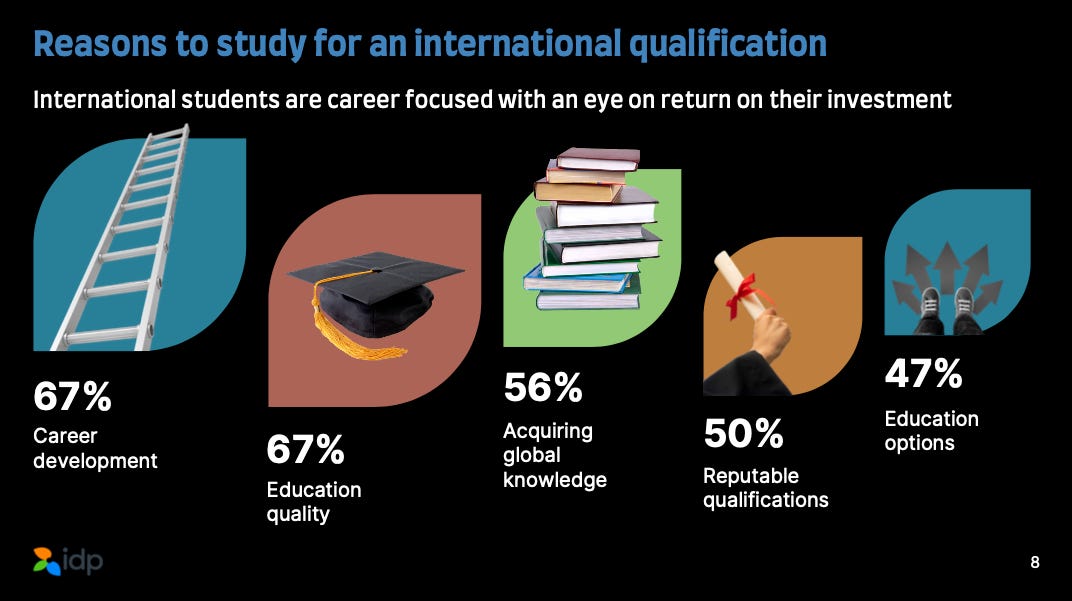
International students increasingly choose institutions and programs based on labor markets. According to IDP’s Emerging Futures 7 survey, 67% of students cite “career development” and “job outcomes” as their primary motivation for studying abroad, slightly edging out “education quality”.
And vice versa.
Nations increasingly develop national talent strategies not to “fill seats” but “fill gaps” due to demographic declines and labor market gaps, according to the OECD Education at a Glance 2025.
But the labor market for recent college grads is anxiety-inducing. If you have college-age children (or ones that might go soon), the uncertainty is palpable, and the New York Fed’s “The Labor Market for Recent College Graduates” will not calm your nerves.
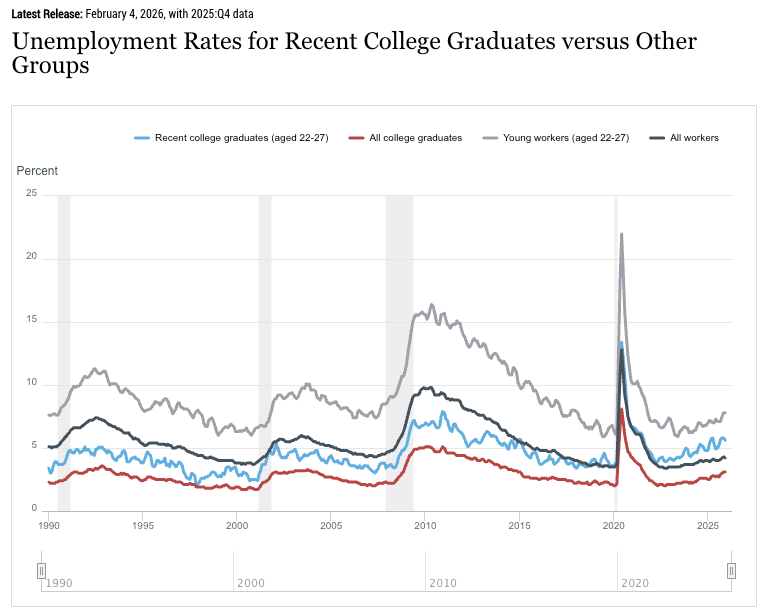
In 2025, the historic employment advantage held by college graduates shrank considerably with an underemployment rate of 42.5%, the highest level since 2020.
Now consider the fields the Anthropic Economic Index indicates will be most impacted by artificial intelligence (job reconfiguration, not just displacement).
For the roughly 300,000 international students on OPT, students concentrate in the top three fields which qualify for the 24-month STEM OPT extension
computer science,
engineering, and
business analytics.
Computer Science attracts roughly 1 in every 5 international students. No other single major comes close. It’s also the most likely to be impacted by artificial intelligence, which uniquely targets high-wage cognitive tasks, unlike past technological revolutions that automated physical labor.
This has undoubtedly intensified the competition in the tech job market that has shrunk its entry-level hiring pool. Most studies about the benefits of international students were conducted in growing labor markets; tighter entry-level market makes the presence of international applicants more politically fraught.
Entry-level hiring in software engineering is a 25% below levels just two years ago. The data analytics market has fared better but is saturated by a massive influx of graduates holding newly minted Master’s degrees in Business Analytics.
This is not a problem that can be solved by citing aggregate statistics of economic impact or labor market studies from the 2010s (which most talking points are based on). It is a structural problem that requires a structural solution.
QS mines hundreds of millions of job postings a year to understand regional labor-market needs, and that the opportunity lies in matching what your institution does best to where that expertise is most needed.
Evidence about programs aligned with the labor market is good for everyone, from prospective students to policymakers.
Where the Labor Market is Heading
So where is the growth?
The answer isn’t in the programs that generated revenue five years ago. It’s in three zones that most institutions aren’t yet well-positioned to serve.
The first is the intersection of AI and domain expertise. The labor will reward people who can apply AI to hard problems — in healthcare, climate science, materials engineering, supply chain logistics, public infrastructure.
The second is the care and coordination economy. Healthcare delivery, education, social services, elder care. These represent enormous unmet labor demand across every OECD country and resist automation.
The third is the emerging infrastructure of AI itself. Companies are aggressively hiring for roles that barely existed two years ago: AI engineers, MLOps leads, and AI security specialists. The institutions that design programs around what this work actually requires will have a structural advantage.
What must be “foreseen” are the new programs, curricula, and career pathways that connect to where the labor market is actually heading, not fast-growing, money-generating master’s programs from five years ago.
The historical pattern shows the transition period from the old economy and the new one can be genuinely painful. Workers are displaced. Programs close. Institutions that built their models around the old demand structure face real existential pressure.
Asking What is this making possible? doesn't mean ignoring the carnage of transition. It means refusing to let today's headlines (the seen) become a cause for panic, and instead strategically positioning your institution for what comes next (the foreseen).
And the foreseen, it turns out, is more promising than the field’s current mood suggests.
Delivery, Not Demand
Ben Webb, Executive Director of North America for QS, brought new data to the plenary from the United States Mobility Report, and his central finding reframes everything else in the conversation: international student demand has never contracted. Not once since 1970. This past year it grew at 3.9 percent.

The demographic engines, Africa and South Asia especially, are structural, not cyclical. By 2050, one in three young people globally will be African. The global market for international education is not shrinking. It is growing in places and in forms that most U.S. institutions are not yet positioned to serve.
Ben pushed the room toward what he called “international education without passports”—the pivot toward delivery models that do not presume physical mobility.
He just returned from India and described an overwhelming appetite—for joint programs, transnational partnerships, branch campuses, and delivery models that do not require a student to leave home to access a world-class education.
His provocation offers an insight the field has been slow to absorb:
The crisis is not a demand crisis. It is a delivery crisis.
He cited the three keys:
a credential that connects to a labor market,
delivered in a way that respects the constraints of their lives,
inside an institution that welcomes them.
Institutions that can answer yes to all three have an advantage even in difficult national policy contexts.
His closing question to the room was pointed:
Is your institution willing and brave enough to meet the market where the market is, rather than trying to drag it into what you want it to be?
Protect the Foundations
Lynn Pasquerella, AAC&U President, grounded the conversation in something critical: the democratic and institutional conditions that make everything else possible.

Her argument was structural and unflinching. The AAC&U’s mission connects liberal education, democracy, and global learning as inseparable. Unless we preserve academic freedom, she argued, we cannot do this work at all.
Her argument was structural and unflinching. The AAC&U’s mission connects liberal education, democracy, and global learning as inseparable. Unless we preserve academic freedom, Lynn argued, we cannot do this work at all.
But her most provocative move wasn’t about defense. It was about reorientation, and it was, in its own way, an answer to the question: What is this making possible? She cited a college president who argues that institutions should stop telling communities what we’re good at and start asking what they need from us.
Remember, hope is hard. It involves a commitment to building better institutions and better futures.
She pointed out that “international education without passports” names something that’s already being designed, at scale, on every continent, not just in response to visa restrictions.
Her remarks made me think about the COIL programs across Latin America that are building cross-border learning, the joint degrees under Erasmus+ and the African Union's pan-African quality-assurance frameworks that foster mobility, as well as the increasing number of countries that have signed on to UNESCO’s Global Convention on Higher Education.
She extended this to questions of equity: How do we create actionable global-learning access for first-generation students who've never left their state? She drew on her own experience: she didn’t travel internationally until after she had finished her graduate studies, but that didn’t mean she lacked global experiences. Global and local learning aren’t opposites. They’re the same project.
She noted the opportunity in the generational shift underway:
Younger employers value cross-cultural competency and diverse team experience more than older employers do. The labor market of the future rewards precisely what global learning develops.
Reclaiming Agency
I closed out the session, sharing that I used to compare international student mobility to a bond—steady, predictable, 3 to 5 percent returns year after year. Now it’s more like Bitcoin. Extremely volatile, yet full of potential.
The Boston Consulting Group (BCG) has a book that captures our challenge in a title: Your Strategy Needs a Strategy. When the environment changes, strategies that worked before won’t necessarily work.
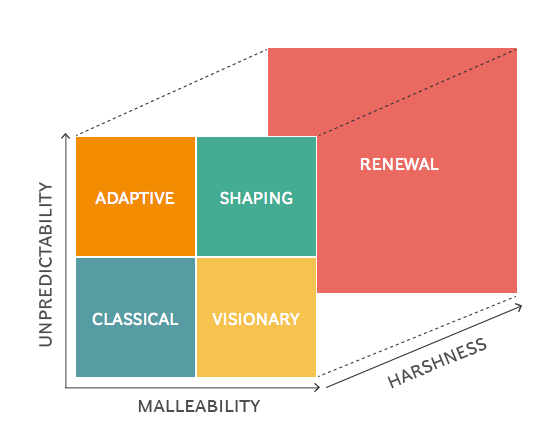
In a K-shaped future, there will be winners and losers. And one thing is certain: the losers will be those that use the past as their strategy.
So, how do leaders exercise agency with a focus on hope through data?
Three principles emerged from our discussion:
The rules have changed.
The old rules of mobility were legible: prestige drove destination choice, diaspora networks reinforced established corridors, and GDP gaps between sending and receiving countries predicted outbound pressure.
Those rules described a world where students chose institutions. The new rules describe a world where nations compete for students.
The new rules of mobility follows a pattern I’m calling HALO factors: housing, affordability, labor markets, and openness.
Chinese middle-class self-funding drove decades of global growth, but those enrollments are stagnating as domestic alternatives improve. Future growth comes from South Asia, Southeast Asia, and Africa — students funded by loans and pooled family resources, more price-sensitive, more ROI-demanding.
The Big Four has become the Big Fourteen — Germany, Japan, South Korea, Malaysia, Türkiye, and the Gulf states are streamlining visas and investing in English-taught programs while traditional destinations impose enrollment caps under domestic housing pressure.
With the exception of elite students with significant financial resources who are focused on rankings, new generations of students care about policies and possibilities. They redirect quickly to alternatives rather than waiting.
All data is local.
Former House Speaker Tip O’Neill famously said “all politics is local”. Same goes for data. All data is local. You don’t need to wait for the big study to prove the impact of internationalization; you likely already have the data and just need to put it to better use.
Use your SEVIS data (or the OPT Observatory) to learn which of your programs connect international graduates to high-quality employers, which OPT and STEM OPT placements lead to retained talent in your region and state, and which employers in your metro area are struggling to fill roles that your programs address. Use your study abroad data to track which experiences correlate with degree completion, career placement, and alumni engagement.

Maybe you have the data and they don’t look that great. If so, pivot. Now.
That pivot will give you evidence that international students need about employment outcomes, proof to policymakers that you’re strengthening the community, and counter-evidence that your international strategy multiplies opportunities rather than divides economic opportunity.
Practice internationalization of higher education for society: an outside-in approach where the community’s needs shape the international strategy, not the other way around.
But, the standard model tends to be inside-out: recruit globally, compete on rankings, treat international enrollment as a revenue line.
The outside-in approach starts with the ecosystem — which employers need talent, which industries are growing, which civic priorities demand partnership — then builds international engagement to serve those needs.
Build while others panic.
This is where “the seen” and “the unseen” become operational. Institutions that will lose are the ones that stare at the visible disruption (the enrollment declines, the funding cuts, the visa revocations) and extrapolate doom.
The institutions that will win are the ones that ask: what is this disruption making possible that wasn’t possible before?
The data tells you where to build. Labor market projections tell you which fields have high-demand futures. Regional analysis tells you which countries are opening — not just India, but Qatar, Saudi Arabia, Central Asia, the emerging hubs that barely registered on old mobility maps. Graduate outcomes tell you which partnerships actually delivered and which were just signed.
The Seen and the Unseen
I closed the AIEA plenary with the quote I began this article with. Frédéric Bastiat’s distinction between the seen and unseen that has organized everything I’ve argued here. He writes:
“There is only one difference between a bad economist and a good one: the bad economist confines himself to the visible effect; the good economist takes into account both the effect that can be seen and those effects that must be foreseen.”
When disruption arrives, certain effects are immediately visible. They generate attention-grabbing headlines in Inside Higher Ed. They’re all over social media. They’re tangible, emotional, and have a human face.
They produce a reaction that feels like wisdom but can be misleading: the conviction that the disruption is the whole story. That what’s being destroyed is all there is to see. That reaction overlooks a second category of effects, the ones that emerge only subsequently.
The bad forecaster stares at the seen, extrapolates doom, and completely misses the explosion of new opportunities forming outside the field of vision.
Rorty argued that social progress comes from expanding our capacity to imagine arrangements that don’t yet exist—and then testing those visions against evidence.
That’s exactly the discipline this moment demands.
Not wishful thinking that comes from looking away. Hope that comes from looking more closely than anyone else, at evidence that reveals not just what is breaking but what is becoming possible.
Hope is not a feeling. It’s something we must practice. And data is its foundation.
2025 sent shockwaves.
2026 is the year to reclaim our agency.
The work now is to pivot towards the future, double-down on our mission, and lead with a positive vision powered by hope.
Hope that requires something of us.
Hope that demands effort and evidence.
Hope through data.
@online{glass2026hopethroughdata,
  author = {Glass, Chris R.},
  title  = {Hope Through Data: Reclaiming Agency in International Education},
  date   = {2026-02-23},
  year   = {2026},
  url    = {https://chrisrglass.substack.com/p/hope-through-data},
  note   = {Remarks delivered at the closing plenary of the Association of International Education Administrators (AIEA) Annual Conference},
}
Truly insightful Chris! Thanks for this important message and pedagogy: hope through data!